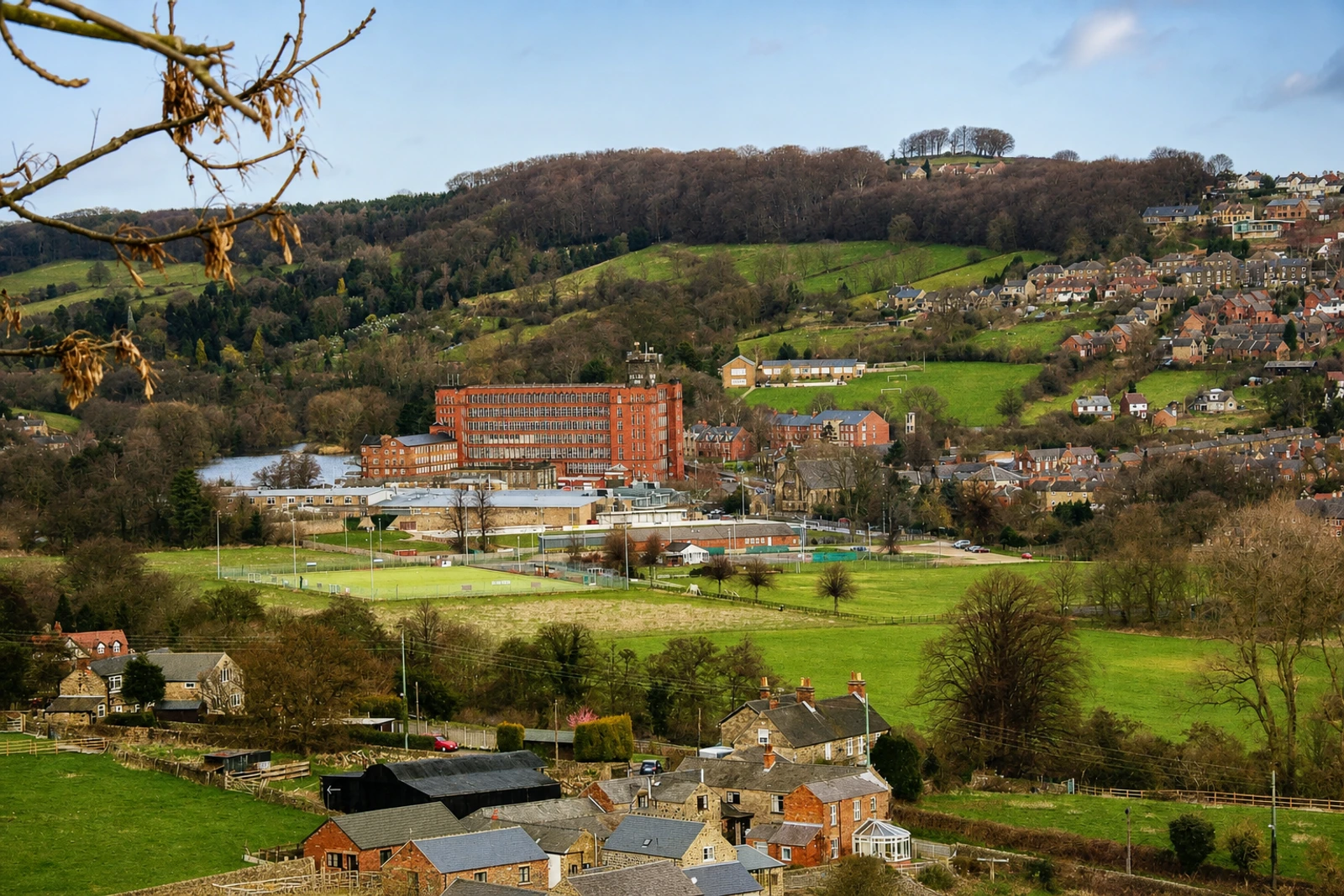
Derwent Valley Mills: where factory and settlement meet
Derwent Valley Mills is the map’s clearest example of a water-powered industrial landscape developing within a rural valley. The property runs upstream from Derby and includes 18th- and 19th-century cotton mills, workers’ housing and associated settlements. Its story begins with the Lombes’ Silk Mill in Derby in 1721, but the decisive development came at Cromford, where Richard Arkwright’s water-powered spinning mills of 1771 and 1776–77 established industrial-scale cotton production. This makes the property different from mining landscapes based on extracting minerals from the ground.
The River Derwent connects the four principal industrial settlements of Cromford, Belper, Milford and Darley Abbey. Water supplied power to the mills, while the arrival of industrial buildings in a rural setting required housing and facilities for workers and managers. Intact workers’ housing extends across 24 kilometres from near Matlock Bath towards Derby. Canals, railway, tributaries and surrounding topography complete the picture, so the most meaningful details may lie between the best-known mill buildings.
Some industrial buildings were altered for later uses, but original forms, materials and structural techniques remain discernible; lost buildings have not been reconstructed. The valley’s setting is vulnerable where large-scale development could alter settlement scale. The property is practical for a half-day or full-day visit, with Cromford or Belper as nearest practical rail gateways and selected mill settlements linked by railway and riverside paths. Check individual mill-tour information before travelling, and allow time to read the river, housing and landscape alongside the machinery.