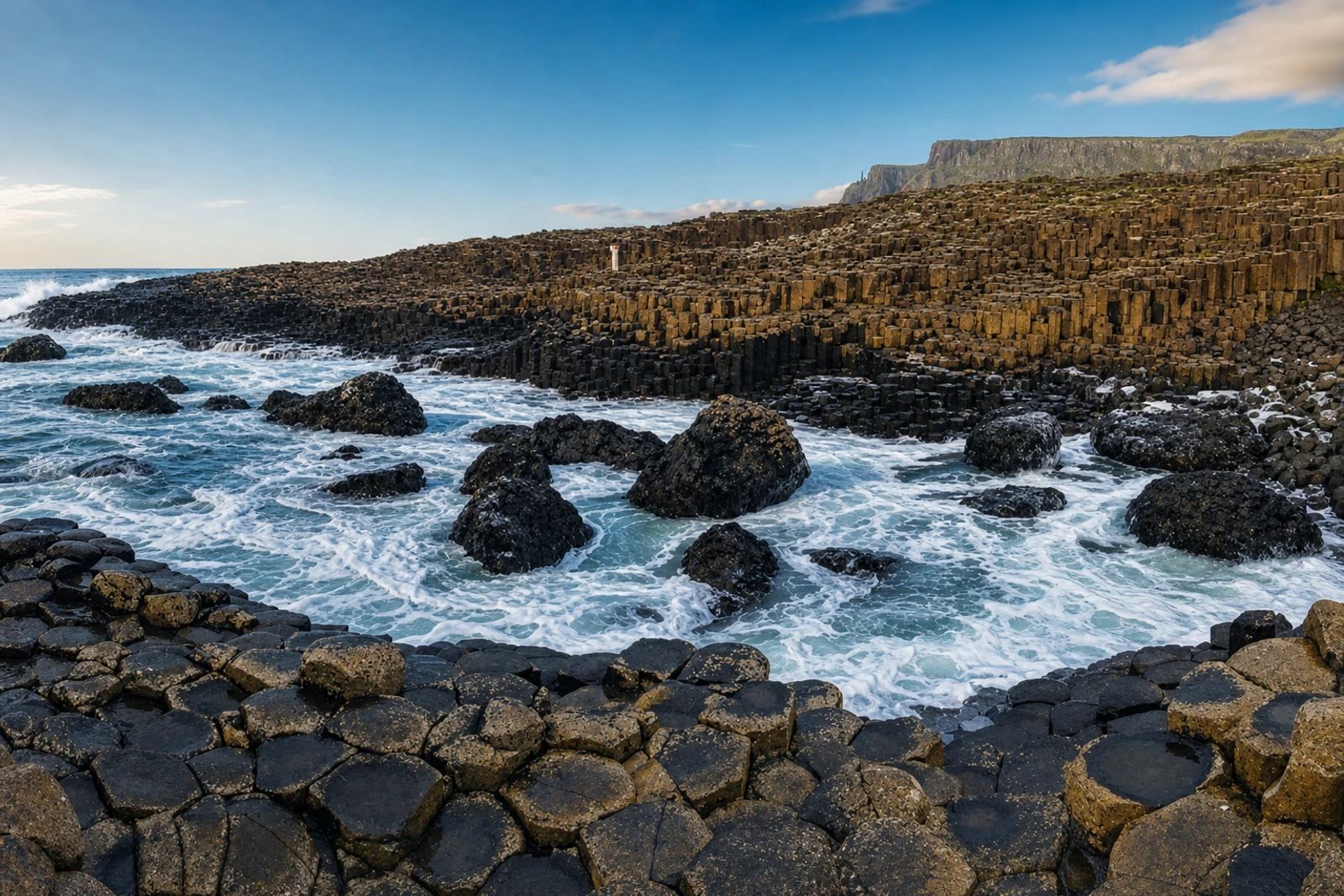
Giant’s Causeway: basalt columns at the Antrim coast
Giant’s Causeway and Causeway Coast is a natural World Heritage property on the sea coast at the edge of Northern Ireland’s Antrim plateau. Inscribed in 1986 under criteria (vii) and (viii), it is defined by an exposure of around 40,000 regularly shaped polygonal basalt columns. They form near-horizontal sections, including the Causeway pavement extending into the sea, while the surrounding cliffs reveal a wider succession of lava flows and interbasaltic beds.
That geological setting distinguishes the property from a general scenic coastal stop and from the nearby identity of “the Giant’s Causeway” alone. Volcanic activity during the Tertiary, around 50–60 million years ago, produced the formations; studies of the cliffs and columns have contributed to understanding geological activity in the North Atlantic. The regular columnar jointing is the detail to examine at close range, while the cliff-top paths show how the pavement relates to the larger coastal setting. Legends of giants crossing towards Scotland are part of the site’s cultural association, not an alternative explanation of its geology.
The property covers 70 hectares, most managed by the National Trust, with footpaths linking cliff-top views and close access to geological features. It also has overlapping nature and landscape designations, including a National Nature Reserve and the Causeway Coast Area of Outstanding Natural Beauty. Coleraine is the practical rail gateway, followed by a bus connection to the visitor area. Allow two to four hours, and book visitor experience parking and admission. Do not remove stones: the causeway features are protected.