Jodrell Bank: a working observatory made visible
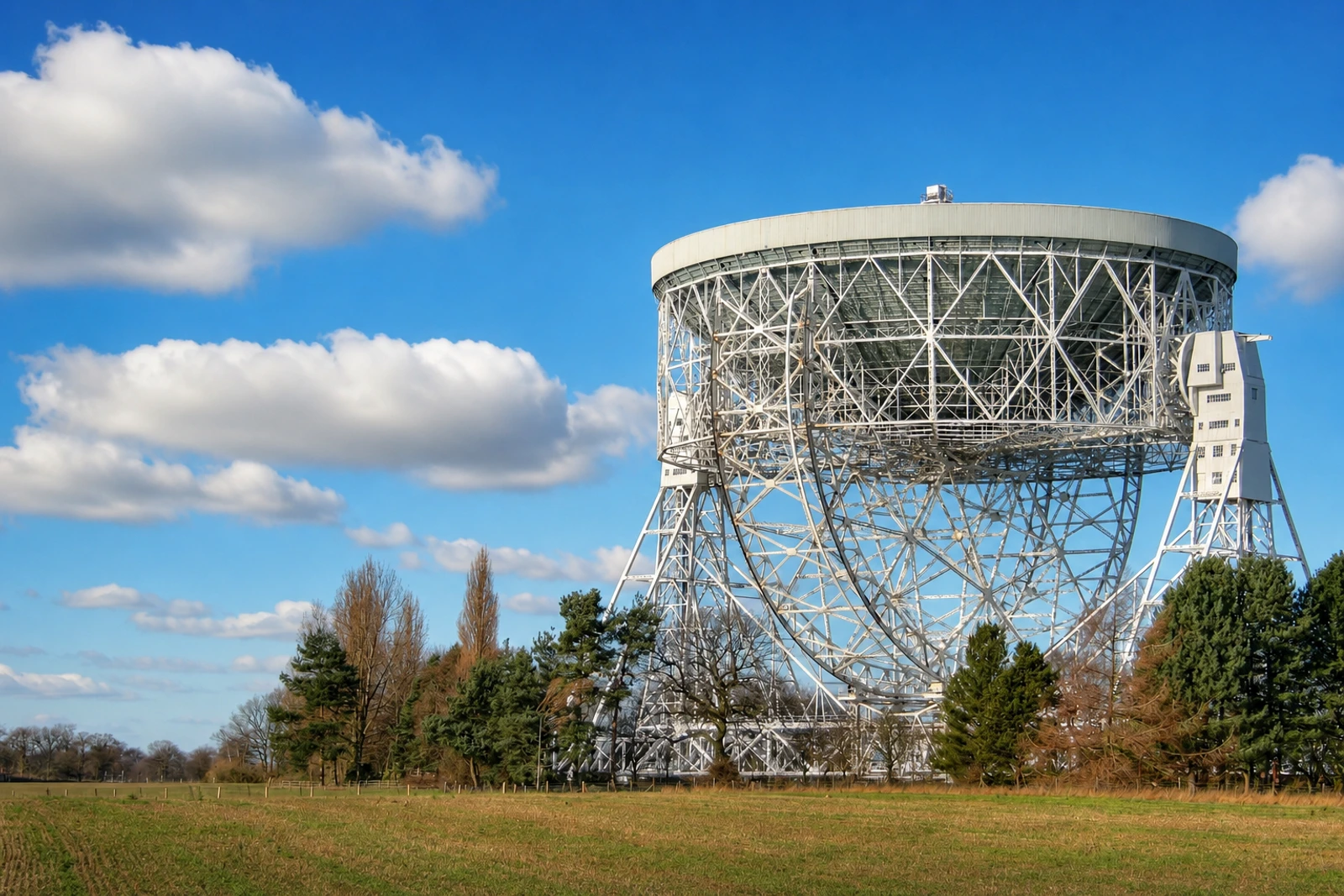
Jodrell Bank Observatory is the map’s clearest choice for scientific heritage. Inscribed in 2019, it is a cultural property in rural northwest England where freedom from radio interference supported the development of radio astronomy. The observatory began as a research site in 1945 and still operates. Its significance is therefore not based only on historic equipment, but on an ensemble that records the movement from pioneering research to sophisticated, large-scale activity.
The site is arranged as a sequence of scientific work. At the south end, the Mark II Telescope stands with modest research buildings associated with early activity. North of the Green, the 76-metre Lovell Telescope dominates a working compound containing engineering sheds and the Control Building. Remnants of earlier instruments also survive. These details distinguish Jodrell Bank from Maritime Greenwich: both connect astronomy with navigation or observation, but Jodrell Bank focuses on radio astronomy, radar adaptation and research beyond visible light.
The observatory’s work contributed to research on meteors and the Moon, quasars, quantum optics and spacecraft tracking. It is also the hub of e-MERLIN, the UK’s national wide array of up to seven radio telescopes, including the Lovell and Mark II. Visitor facilities around the Lovell Telescope sit within the property, while other facilities are outside it. Allow two to four hours, use Goostrey as the practical rail gateway, and consider Discovery Centre tickets in advance.