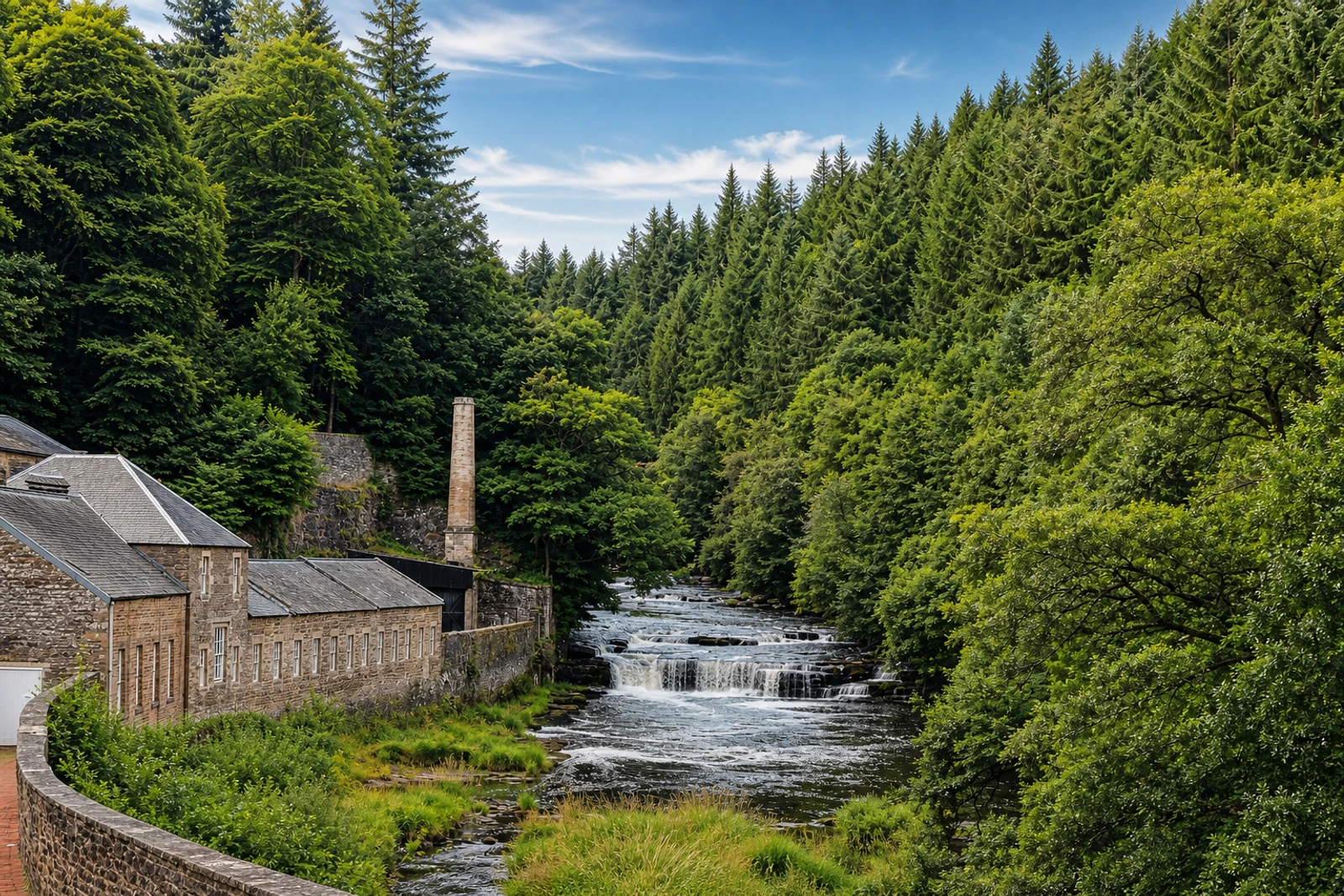
New Lanark: the mill village shaped by Robert Owen
New Lanark is the strongest choice on this map for visitors interested in the relationship between industrial production, settlement planning and workers’ welfare. Founded in 1785 near the Falls of Clyde, it developed around cotton mills powered by water-wheels. The mills operated from 1786 to 1968, but the UNESCO property is not simply an industrial ruin: it preserves the village, its housing, educational buildings and the social ideas associated with Robert Owen.
Owen moulded New Lanark into a model industrial community in the early 19th century, building on David Dale’s actions and applying his own form of benevolent paternalism. The imposing mills, spacious workers’ housing, educational institute and school show how architecture and planning were integrated with concern for residents’ physical and spiritual needs. This is the key contrast with Ironbridge Gorge, whose larger valley landscape records a network of extraction, manufacture and transport across several communities.
The village’s appearance remains close to the early 19th century, based on physical evidence, archaeology and archival material. Conservation has used traditional materials, workmanship and original designs where possible, while the original weir, lade and waterways remain in use. The place also connects industrial history to progressive education, factory reform, humane working practices and garden-city ideas. A half-day visit works from Lanark by bus, taxi or signed walk; visitor attraction admission is recommended.