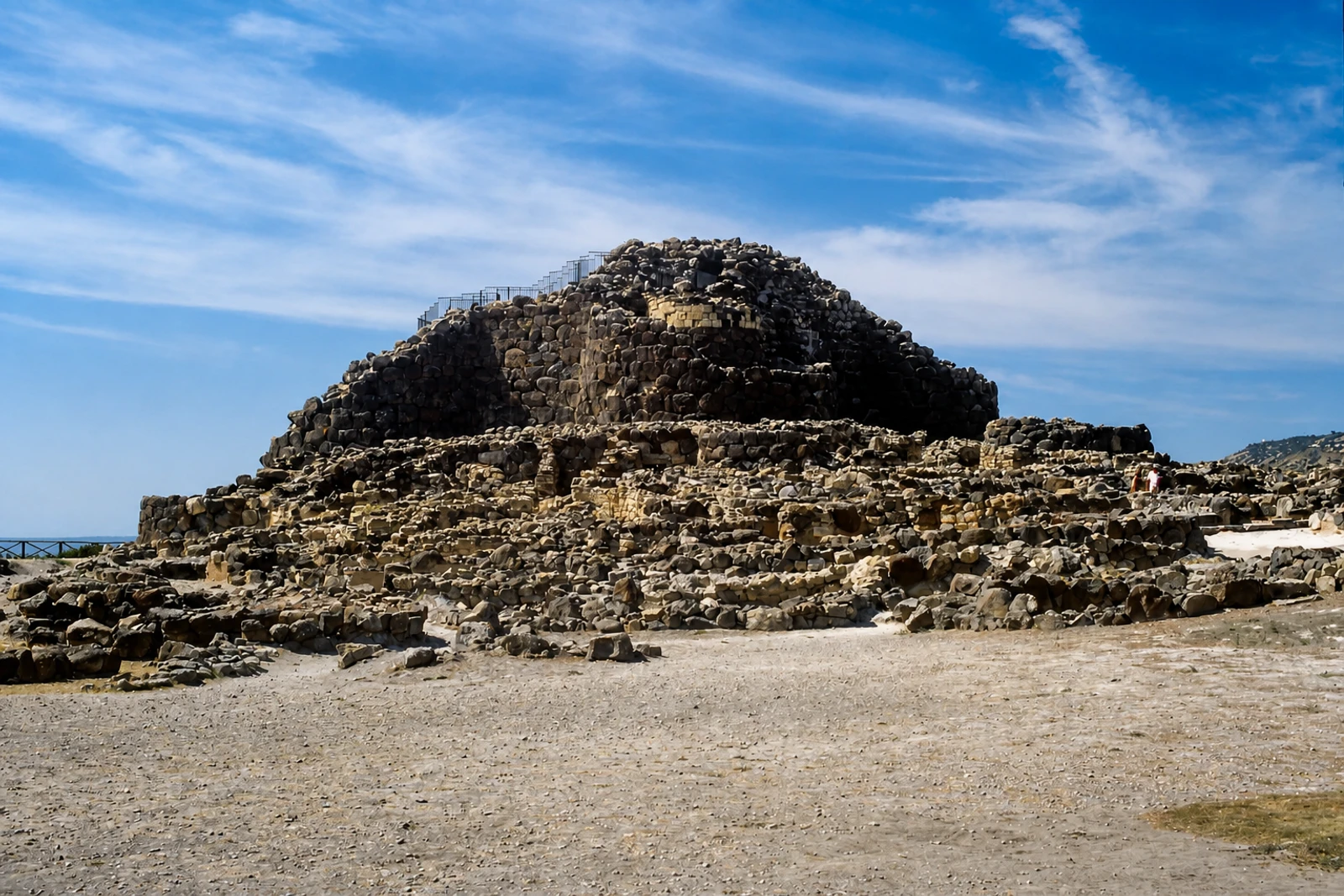
Su Nuraxi: Sardinia’s fortified Bronze Age settlement
Su Nuraxi di Barumini belongs because it concentrates Sardinia’s distinctive nuraghi tradition in an exceptionally complete archaeological complex. Built on elevated ground west of Barumini, it overlooks a fertile plain and shows how a circular defensive tower developed into a larger fortified settlement. Nuraghi are unique to Sardinia: their truncated-cone towers, dressed stone and corbel-vaulted chambers have no parallel elsewhere in the supplied UNESCO record. The site was inscribed as a cultural property in 1997.
The central tower is the detail that separates Su Nuraxi from a simple prehistoric fort. Originally more than 18.5 metres high, it contained three chambers linked by a spiral staircase, although the uppermost chamber no longer survives. Four subsidiary towers formed a quadrilobate structure around it, joined by a massive curtain wall. A courtyard was later roofed, restricting access to the central tower. Beyond the core are a second outer wall and circular huts, showing the settlement’s expansion as society became more complex and hierarchical.
Su Nuraxi also records change over time rather than a single construction phase. The complex was reinforced in the first half of the 1st millennium BCE under Carthaginian pressure, abandoned in the 6th century BCE and intermittently occupied later; excavations indicate habitation continued until the 3rd century CE. The original planimetric layout remains clear and the buried structures retain high authenticity. A provincial road along the northern boundary affects perception of the archaeological landscape, so the setting deserves as much attention as the masonry itself.