
.jpg)
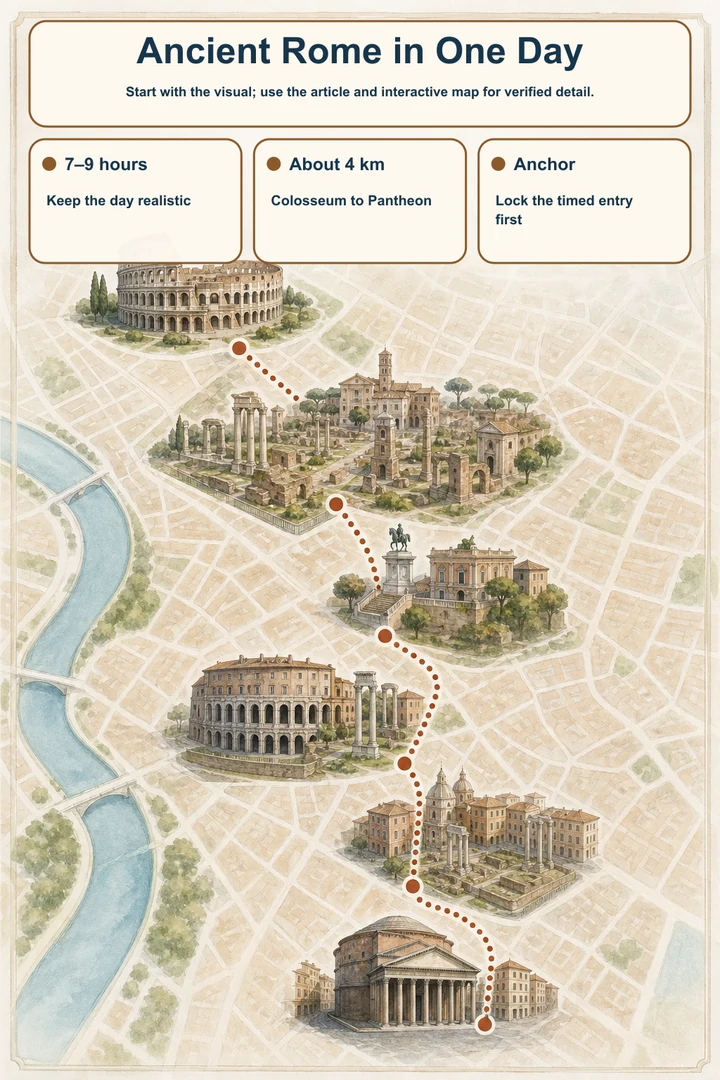
Start with the visual; use the article and interactive map for verified detail.
- 7–9 hoursKeep the day realistic
- About 4 kmColosseum to Pantheon
- AnchorLock the timed entry first
Route at a glance
Colosseum → Roman Forum → Palatine Hill → lunch break → Capitoline Museums and Tabularium → Theatre of Marcellus → Porticus Octaviae → Largo di Torre Argentina → Pantheon.
Treat the Roman Forum and Palatine Hill as one uninterrupted archaeological visit. Do not leave the area expecting to re-enter unless your current ticket specifically permits it. The route then moves downhill and west through central Rome, with the Pantheon as the final stop.
A realistic sample day
Use this as a relative schedule, then shift it to match your Colosseum slot. A 9:00 a.m. Colosseum entry produces a workable day:
9:00–10:30 a.m.: Colosseum, including the timed security process and visit.
10:30 a.m.–1:00 p.m.: Roman Forum and Palatine Hill as one continuous visit. Keep the Forum-Palatine ticket and follow the gate stated on it.
1:00–1:45 p.m.: Lunch break outside the archaeological area. Allow enough time to eat without turning the afternoon into a race.
2:00–3:30 p.m.: Capitoline Museums and Tabularium. The Tabularium gallery is the day’s principal elevated view over the Roman Forum.
3:30–4:00 p.m.: Walk to and view the Theatre of Marcellus.
4:00–4:30 p.m.: Porticus Octaviae and the surrounding Jewish Ghetto pedestrian area.
4:30–5:15 p.m.: Largo di Torre Argentina, followed by the walk to the Pantheon.
5:15–6:00 p.m.: Pantheon, if your separate admission, official hours, worship schedule, and ticket rules align. The route may finish earlier or later depending on the Colosseum slot and the time spent inside the museums.
Tickets and dependencies
The Colosseum is the anchor: reserve a timed admission through the official ticketing service and verify the selected ticket’s release window. Arrive before the timed security window at Piazza del Colosseo.
Eligible Colosseum/Forum-Palatine tickets cover the Roman Forum and Palatine Hill, but check the exact ticket conditions, including any SUPER-site access. Plan to enter the two areas as one visit; do not build the day around Forum-Palatine re-entry.
The Capitoline Museums and Tabularium require a municipal museum ticket. Verify the current galleries and temporary exhibitions. The Pantheon is separate from the Colosseum route and requires its own current admission check, including official hours, worship closures, and ticket rules. Street views of the Theatre of Marcellus and Porticus Octaviae do not require a separate ticket for the public exterior route. Largo Argentina’s street overlook is free, while the lower archaeological walkway follows separate current rules.
How to use the route map
Start the map at Metro B Colosseo and finish at Piazza della Rotonda. The walking order is intentionally linear: the first half concentrates on the large archaeological area, while the second half uses short urban hops through the Capitoline, Theatre of Marcellus, Jewish Ghetto, Largo Argentina, and Pantheon.
The approximately 4-km figure describes the sightseeing route itself, not your journey from a hotel, station, or airport. Add time for arrival before the Colosseum slot and for departure after the Pantheon. Wear shoes suitable for uneven Forum paving, hills, stairs, slopes, and central-Rome cobbles.
What to cut when the day changes
For a winter day with limited daylight, keep the timed Colosseum, the Forum-Palatine visit, and the Capitoline view. Shorten the museum visit or use the exterior stops as brief looks rather than trying to add another major site.
In high heat, take the lunch break seriously, reduce time on the exposed Palatine Hill, and prioritize the Forum sections that matter most to you. In rain, cut the Theatre of Marcellus and Porticus Octaviae first if you need to protect time for the ticketed interiors. Largo Argentina can remain a brief street-edge stop.
If mobility or uneven ground is a concern, do not treat the full Forum-Palatine circuit as interchangeable with a level route. Consider a shorter visit at the Forum’s designated current entrance, use the Capitoline Museums only if the stairs and slopes work for you, and rely on the public exterior views at the Theatre of Marcellus and Porticus Octaviae. Largo Argentina is level at the street edge, while its lower walkway uses a designated entrance; verify current access arrangements before relying on it.
What not to add
Do not add the Appian Way, Ostia, Domus Aurea, or Hadrian’s Villa to this day. Each would break the route’s compact walking logic and put the timed Colosseum, Forum-Palatine visit, or Pantheon at risk. This plan is deliberately ancient-Rome-focused and already fills a 7–9 hour day.
Places in this article
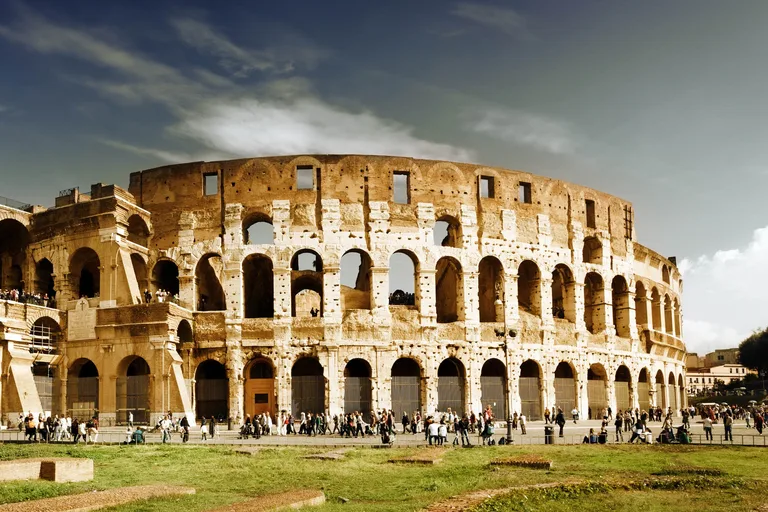
1. Colosseum: anchor the day here
Begin at the Colosseum, also known as the Colosseo, at Piazza del Colosseo. Metro B serves Colosseo, but your arrival journey is outside the route’s 7–9-hour estimate.
Allow 75–90 minutes for the visit. Admission is timed, so buy through the official ticketing service, verify the selected ticket’s release window, and arrive before the timed security window. This fixed appointment should determine your day’s starting time.
Sam valadi · CC BY 2.0Image source
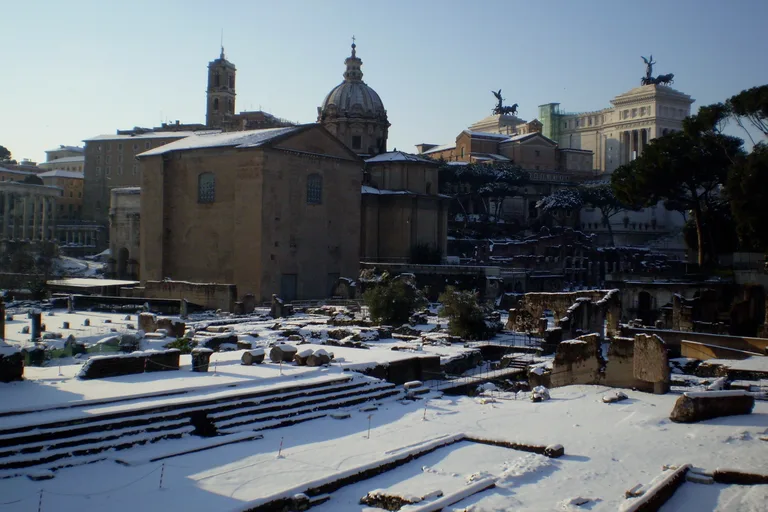
2. Roman Forum: continue without breaking the visit
From the Colosseum, continue into the Roman Forum, the Foro Romano. Allow 90–150 minutes, depending on how much of the archaeological area you explore and how quickly you move over its uneven paving.
Use the gate specified by your current ticket. The Forum is normally part of the same entry structure as the Colosseum and Palatine Hill, so do not leave the archaeological area on the assumption that you can return later.
Barbaking · CC BY-SA 3.0Image source

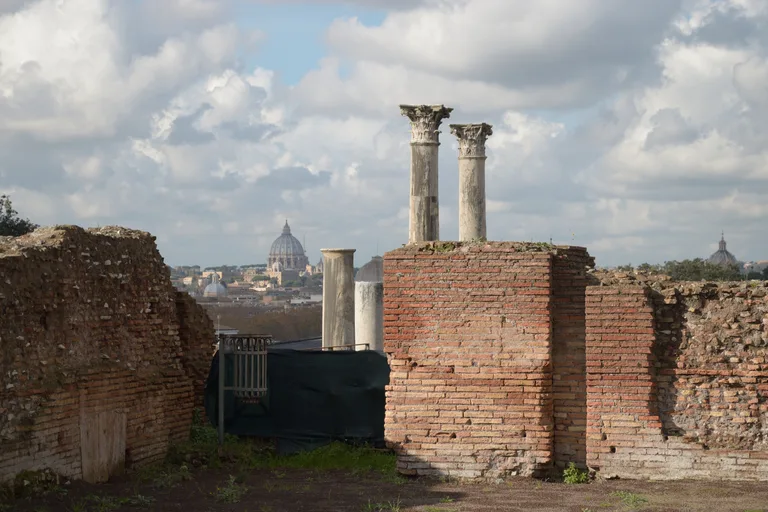
3. Palatine Hill: make it one Forum-Palatine circuit
Continue directly from the Forum to the Palatine Hill, or Palatino, without planning a gap between the two. Together, they merit another 90–150 minutes within the same continuous visit.
Expect steep and uneven sections. The hill supplies the route’s imperial-palace context and views, but it is also the first place to shorten in extreme heat or when walking ability is limited. Check whether your chosen ticket includes SUPER-site access.
Livioandronico2013 · CC BY-SA 4.0Image source

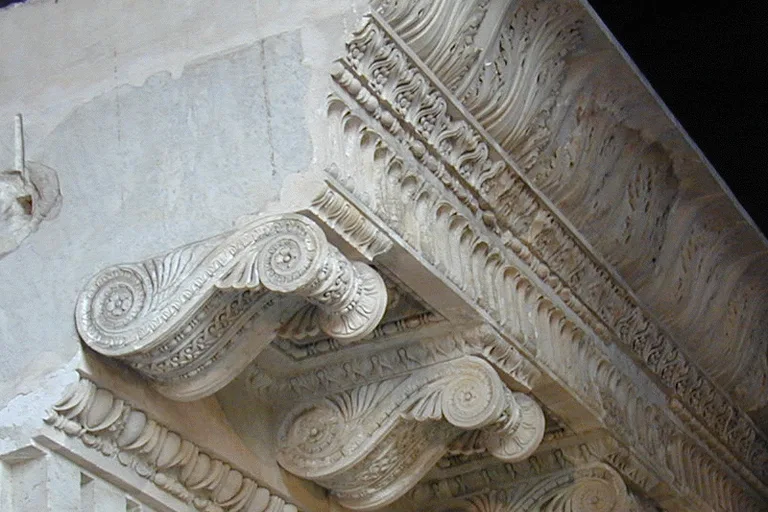
4. Capitoline Museums and Tabularium: the Forum from above
After the Forum-Palatine area, pause for lunch before climbing toward Piazza del Campidoglio. Then allow 90–120 minutes for the Capitoline Museums and Tabularium.
The Tabularium gallery provides a key view over the Roman Forum, giving the archaeological area a useful visual reset after the ground-level visit. The Capitoline approach includes stairs and slopes, and the museum requires a municipal ticket; verify current galleries and temporary exhibitions.
user:Lalupa · Public domainImage source

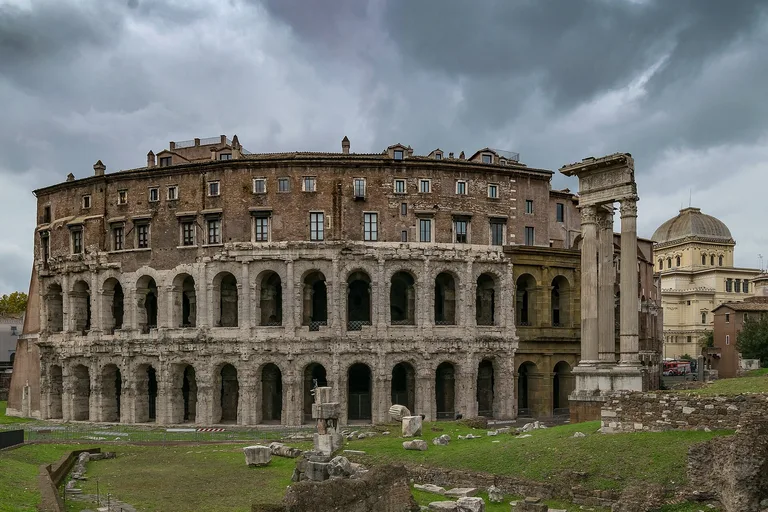
5. Theatre of Marcellus: a compact exterior stop
Walk downhill toward the Theatre of Marcellus on Via del Teatro di Marcello. Allow 20–40 minutes for the exterior route and architectural view.
This is best treated as a public street-side stop rather than another fixed interior appointment. Special access varies, so keep the visit flexible and combine it with the nearby Porticus Octaviae.
Rabax63 · CC BY-SA 4.0Image source
.jpg)
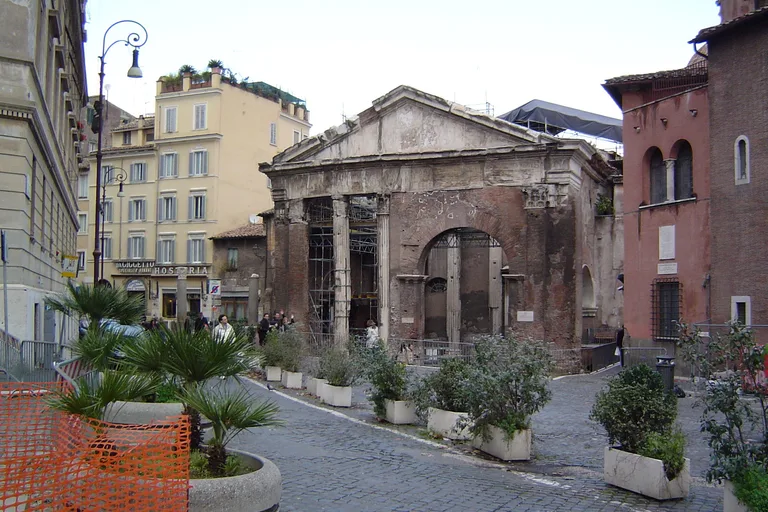
6. Porticus Octaviae: urban archaeology in the Jewish Ghetto
Continue on foot to the Porticus Octaviae, or Portico d’Ottavia, in the Jewish Ghetto pedestrian area. Allow 20–30 minutes for the public exterior archaeological route.
There is no separate ticket for the street view. Its proximity to the Theatre of Marcellus makes it a sensible paired stop, especially when heat, rain, or a late start requires a shorter afternoon.
Joris1919 · CC BY-SA 3.0Image source

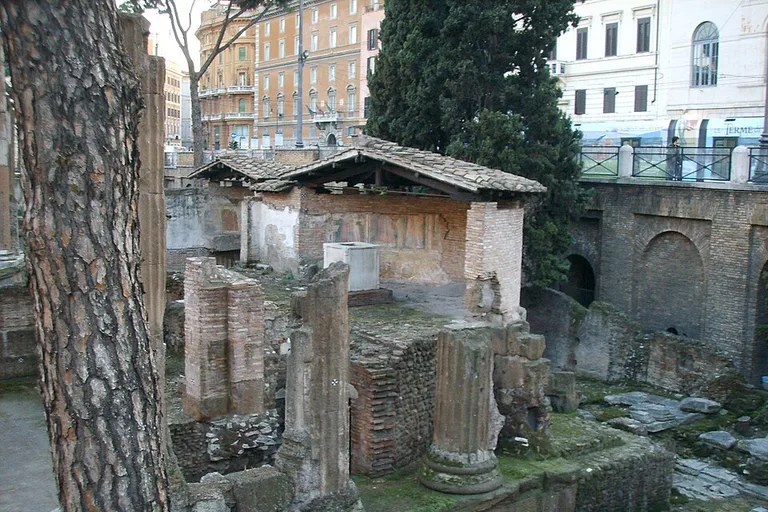
7. Largo di Torre Argentina: a brief Republican-Rome pause
Walk west to the Sacred Area of Largo Argentina, also called Largo di Torre Argentina or Area Sacra. Allow 30–60 minutes if you use the current archaeological access; a street overlook works as a shorter alternative.
The street edge is central and level. The lower archaeological walkway uses a designated entrance and follows separate current rules, so verify those arrangements before making it part of a timed plan.
sailko · CC BY 2.5Image source

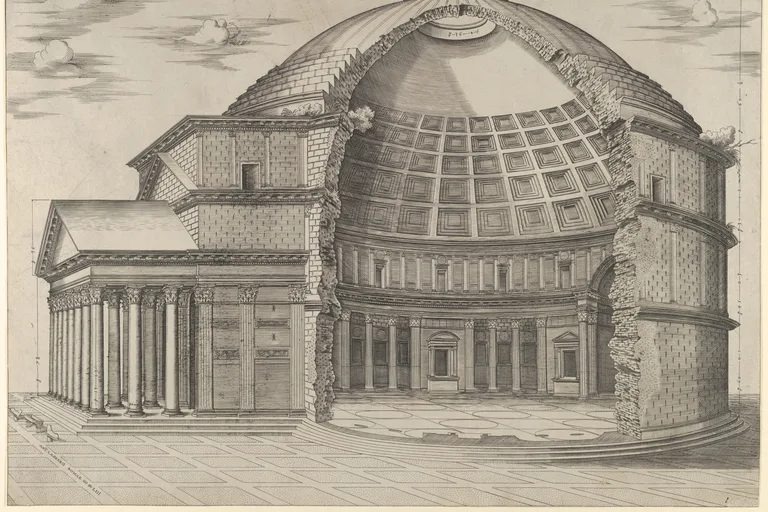
8. Pantheon: finish with a separate ticket check
End at the Pantheon in Piazza della Rotonda. Allow 45–60 minutes, with the mostly level approach still involving central-Rome cobbles.
The Pantheon is separate from the Colosseum and Forum-Palatine ticket system. Before relying on this final stop, verify official hours, worship closures, and ticket rules for your date. If the schedule no longer works, preserve the exterior arrival and treat interior admission as optional rather than rushing the earlier route.
anonymous · CC0Image source

Can I visit the Roman Forum and Palatine Hill separately?
Plan them as one uninterrupted archaeological visit. Eligible Colosseum/Forum-Palatine tickets cover both, but check the current ticket conditions and do not assume re-entry after leaving.
Is the Pantheon included with the Colosseum ticket?
No. The Pantheon has separate admission rules. Verify its official hours, worship closures, and ticket requirements for your date.
Where does this walking route start and end?
It starts at the Colosseum, near Metro B Colosseo, and ends at the Pantheon. The roughly 4-km estimate excludes travel to the Colosseum and onward travel after the Pantheon.
What is the best backup if I am running late?
Protect the Colosseum timed slot and the continuous Forum-Palatine visit first. Then shorten or skip the Theatre of Marcellus and Porticus Octaviae, and treat Largo Argentina as a brief street overlook.
Is this route suitable for limited mobility?
Some sections are not: the Forum and Palatine include uneven or steep ground, and Capitoline access includes stairs and slopes. A shorter archaeological visit, exterior views at the Theatre of Marcellus and Porticus Octaviae, and the level street edge at Largo Argentina may be more practical, subject to current access arrangements.