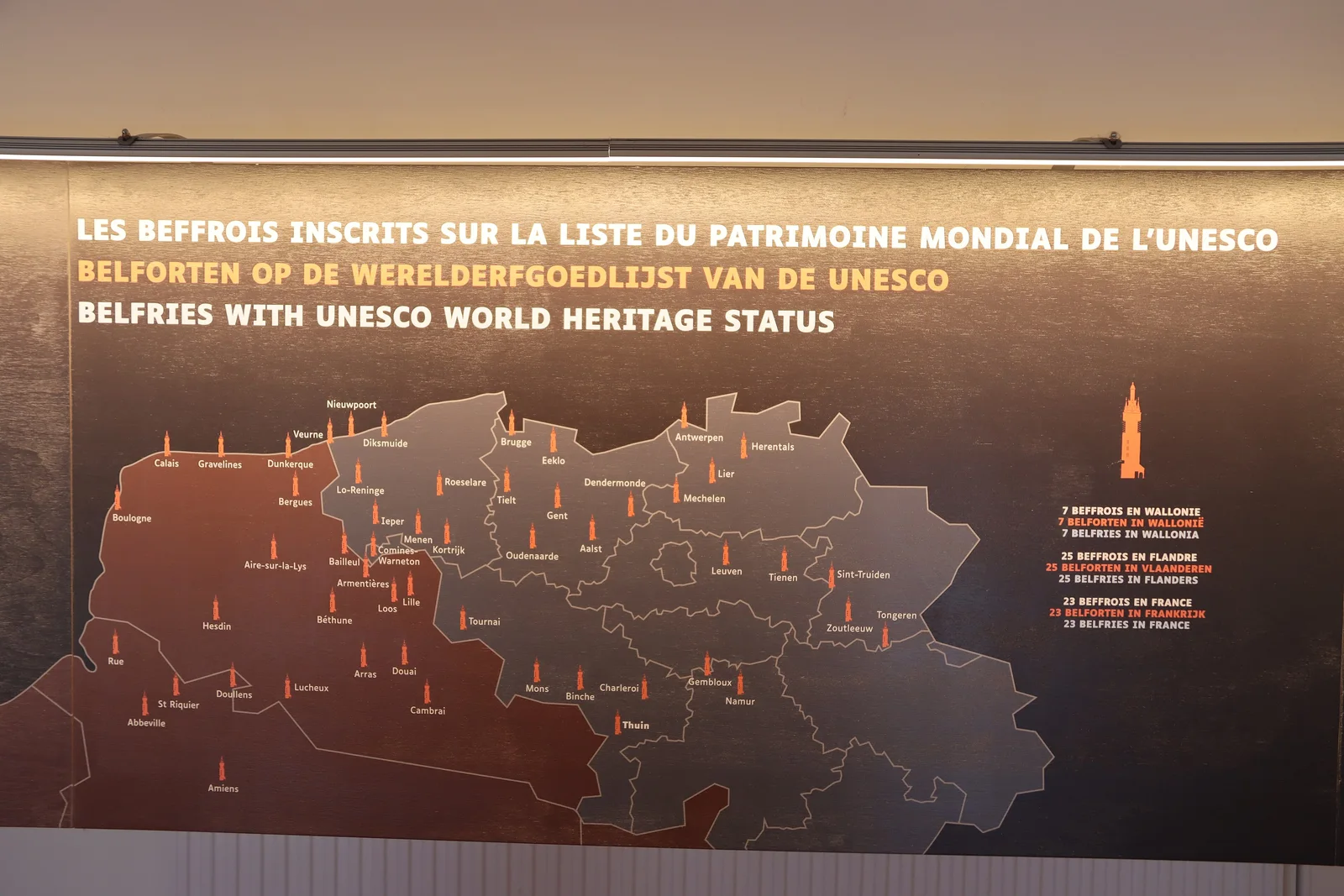
Belfries of Belgium and France: towers of communal power
The Belfries of Belgium and France form a transboundary serial property of 56 component parts, including 23 belfries in northern France and 33 in Belgium. Inscribed in 1999 and classified as cultural under criteria (ii)(iv), the property belongs on this map because it expresses a civic tradition through a family of urban towers rather than through one single building. Each French point should be understood within that wider shared ensemble.
A belfry is not simply a church tower. In the medieval town it could house communal bells, charters and treasures, host council meetings, serve as a watchtower and function as a prison. In this urban setting it symbolised municipal power, contrasted with the seigneurial keep and the church bell tower. Some examples stand alone, some attach to a market place or town hall, and in other cases a church belfry carries the civil role.
The property’s range also prevents a common planning mistake: expecting one uniform architectural style. The towers extend from the 11th to the 20th century and include Roman, Gothic, Renaissance, Baroque and Art Deco forms. Their associated elements—bells, chimes, battlements and related defensive features—help explain their function. Rebuilding after armed conflict is itself part of their continuing symbolic role and the communities’ attachment to them.