Ironbridge Gorge: an industrial landscape in working scale
Ironbridge Gorge belongs because it preserves a connected industrial region rather than a single bridge or museum. The 5.5 km² property follows a 5 km stretch of the steep-sided, mineral-rich Severn Valley and extends into the valleys around Coalbrookdale and Madeley. Its UNESCO significance is tied to the origins of the Industrial Revolution and to the concentration of mines, furnaces, factories, workshops, warehouses, transport systems, housing and public buildings.
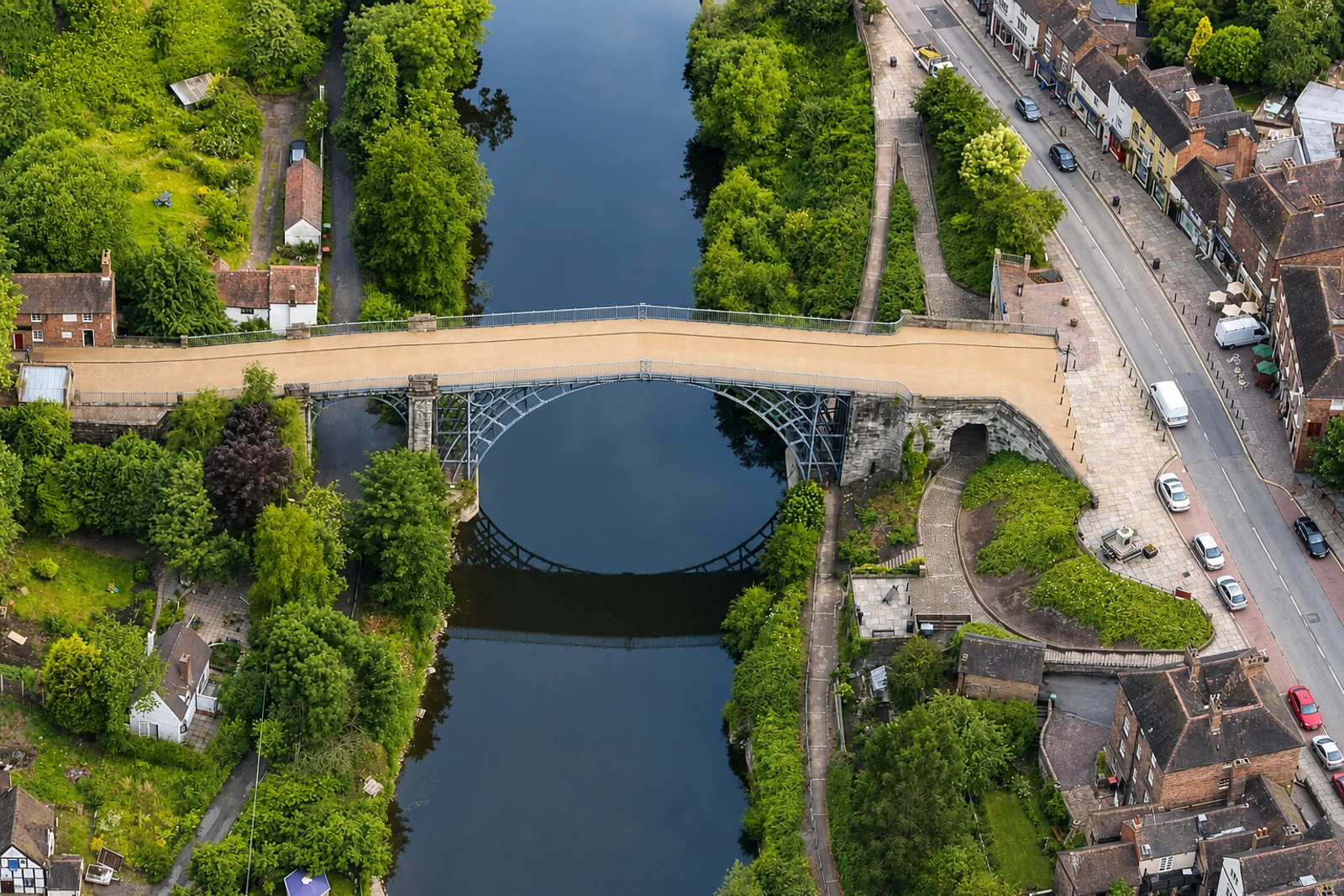
Coalbrookdale is central to the story of iron production: its blast furnace, built in 1708, recalls the discovery of coke, while Abraham Darby I developed the technique of smelting iron with coke instead of charcoal in 1709. In Ironbridge, the bridge erected in 1779 by Abraham Darby III is a key technological and architectural marker. Elsewhere, the remains of the Bedlam Furnaces, Blists Hill works and Hay Inclined Plane show how production and movement were connected.
The property’s range distinguishes it from New Lanark, where a single mill village makes social planning especially clear. Here, the five areas of Coalbrookdale, Ironbridge, Hay Brook Valley with Madeley, Jackfield and Coalport form a broader valley ensemble. Jackfield adds clay production and decorative tiles; Coalport is remembered for its China Works. Museums and heritage organisations interpret the landscape, but it remains a living community, so plan for onward travel between sites from Telford Central.