St Kilda: volcanic islands with a preserved human landscape
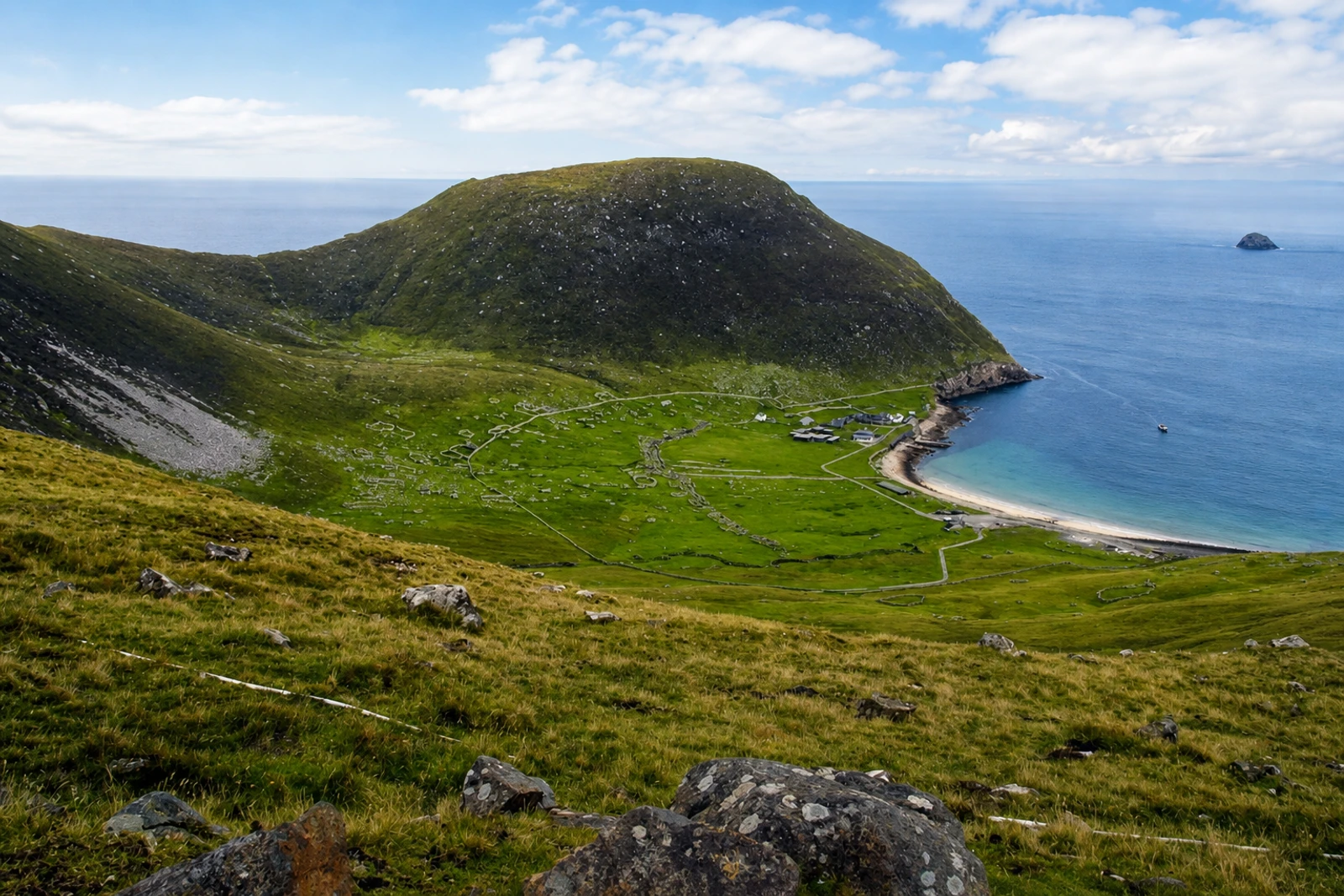
St Kilda belongs in a different category from every other place here: it is a mixed World Heritage property, inscribed in 1986 under cultural and natural criteria. The volcanic archipelago comprises Hirta, Dun, Soay and Boreray off the Hebrides. Its natural identity comes from jagged cliffs, sea stacks, marine richness and major seabird colonies; its cultural identity comes from houses, field systems, cleits and the relict landscape of Village Bay on Hirta.
The contrast between Village Bay’s smooth amphitheatre and the archipelago’s steep, black-faced cliffs is one of the property’s defining visual relationships. Cliffs rising in excess of 375 metres support large populations of Northern Gannet, Atlantic Puffin and Northern Fulmar, while the islands’ isolation has produced the St Kilda Wren and St Kilda Fieldmouse subspecies. Around the islands, oceanic influences and local geology create a richly biodiverse marine environment. These natural qualities sit alongside evidence of more than 2,000 years of intermittent occupation and a subsistence economy based on seabirds, agriculture and sheep farming.
St Kilda is easily confused with a scenic island excursion, but its remoteness and weather exposure are central to planning. The islands have been uninhabited since 1930, and the surviving structures document a cultural tradition that has disappeared. Village Bay is the visit anchor; there is no rail gateway, and licensed boat access from the Outer Hebrides is weather dependent. Allow a full-day expedition or longer, and book the licensed boat well in advance.