
.jpg)
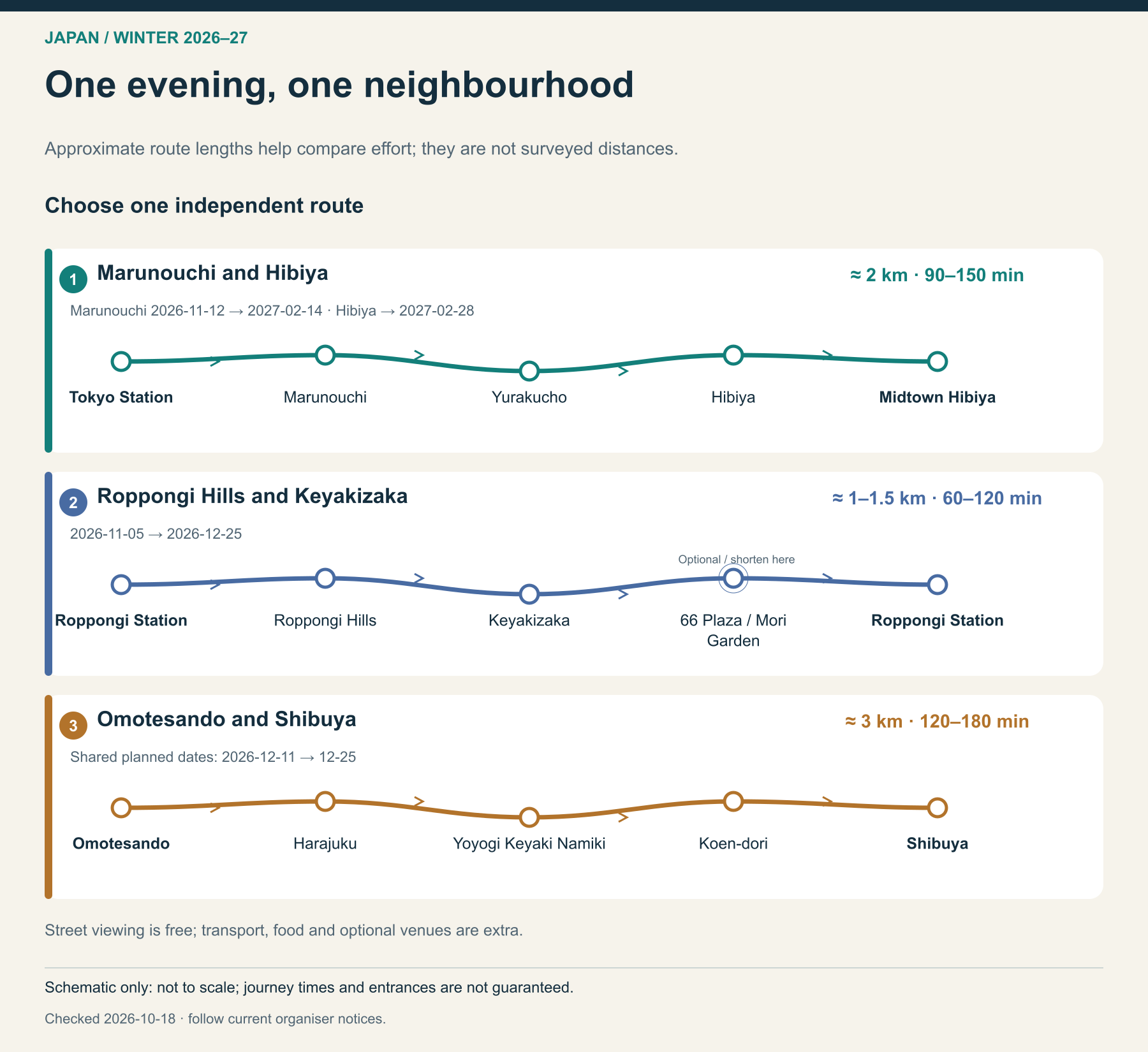
Approximate route lengths help compare effort; they are not surveyed distances. Schematic only: not to scale; journey times and entrances are not guaranteed.
Enlarge the diagramRead the planning notes
- About 2 kmTokyo Station → Marunouchi → Hibiya
- About 1–1.5 kmRoppongi Hills → Keyakizaka → Roppongi
- About 3 kmOmotesando → Harajuku → Yoyogi → Shibuya
- Shorten at any pointChoose an anchor display and a useful return station
Which walk fits your evening?
| Route | Approximate plan | Choose it for |
|---|---|---|
| Tokyo Station → Marunouchi → Hibiya | About 2 km; 90–150 minutes | A flexible first Tokyo lights walk |
| Roppongi Hills → Keyakizaka → station | About 1–1.5 km; 60–120 minutes | A compact evening with slope views |
| Omotesando → Harajuku → Yoyogi → Shibuya | About 3 km; 120–180 minutes | Two contrasting lighting styles; easy to split |
Marunouchi and Hibiya is the easiest route to connect with Tokyo Station sightseeing. The main attraction is a succession of streets and plazas, so you can shorten the walk without losing its character. It is a strong first choice for visitors who value straightforward navigation, several rail exits and the option of a warm meal nearby.
Roppongi is the more compact choice when you want one recognisable streetscape: the illuminated slope of Keyakizaka, with the surrounding Hills plazas adding variety. Its appeal depends less on walking a long distance than on enjoying a few viewpoints properly. There are gradients, crossings and busy photo positions, so a short route does not mean a completely effortless one.
Omotesando and Shibuya offers the greatest contrast between a lit avenue and the blue light of the seasonal event around Yoyogi. It also has the shortest shared seasonal window and the longest connecting walk in this guide. Treat it as two short halves that you can separate, rather than a promise that every visitor should complete the full line.
Our approximate distances describe a simple street-level route, not a surveyed accessible route. The time allowances include slow looking and photographs but exclude a full dinner, shopping and major queues. Building entrances, crowd control and elevator detours can all change the distance. Use the route as a decision aid, then check the live walking directions from your exact station exit.
Match your date to the specific display
Tokyo’s October 2026 metropolitan guide gives Marunouchi’s season as 12 November 2026 to 14 February 2027 and Hibiya’s as 12 November to 28 February. Hibiya’s organizer confirms 16:00–23:00 lighting, while its main Christmas tree finishes on 25 December. The streets and the Christmas programme therefore do not share one end date.
Roppongi Hills’ organizer announces its Christmas event for 5 November to 25 December. Check the current event timetable for individual display hours instead of applying Hibiya’s 23:00 finish to Roppongi. A nearby museum or observation deck also has its own ticketing and closing rules; it is not included in the free viewing route.
For Omotesando, the metropolitan guide lists 1–25 December as planned dates. It lists Blue Cave SHIBUYA for 11–27 December. That makes 11–25 December the intended overlap for the combined route, subject to final operator details. The Blue Cave microsite was still showing the previous season when checked, so this guide does not copy its old daily hours into 2026.
If your visit is before 11 December, the full blue-and-gold combination is not yet supported by the announced schedule. After Christmas, consider Marunouchi and Hibiya for continuing winter illumination. Do not assume that an illuminated shopping district keeps its Christmas tree, market or themed entertainment into January.
Plan backwards from the station where you want to finish
Pick your return station first. A walk ending near the right rail line is more comfortable than finishing with an unnecessary cross-city transfer. In Marunouchi, starting at Tokyo Station and ending at Hibiya or Yurakucho works for many journeys, but reversing the direction may suit a hotel near Tokyo Station. In Roppongi, finish at Roppongi Station unless another verified connection clearly helps. For the longer western route, Shibuya and Harajuku provide obvious places to shorten the evening.
Choose one anchor display and one optional extension. For example, Marunouchi’s tree-lined street is the anchor and Hibiya’s upper garden can be optional. In Roppongi, Keyakizaka is the anchor and the surrounding plazas are the extension. In Omotesando, decide whether the avenue itself is enough before committing to the separate Yoyogi event area. This keeps a queue or a cold child from turning the evening into a failed checklist.
Allow a buffer before dinner. A reservation immediately after a distant photo stop makes even a gentle route feel rushed. If a meal is the important part of the evening, place the final display near that restaurant, or view the lights after an early dinner. Warm drinks and shop visits are optional purchases, not requirements for seeing public illuminations.
Keep a screenshot of the chosen station exit and a simple route on your phone. Large stations can take longer to navigate than the outdoor walk suggests. Do not use a road crossing, bicycle lane or tactile paving as the place where the whole group stops to consult the map.
Make the free route comfortable in real winter conditions
A dry evening is convenient, but there is no guaranteed clear or mild weather. Light rain can make reflections attractive while also making stone paving slippery and crowd movement slower. For sustained rain or strong wind, reduce the outdoor portion to one short segment and use an indoor plan that you have checked separately. A shopping building’s existence does not guarantee that its terraces or every entrance remain open late.
Wear shoes suitable for city walking and a layer that works while you stand still. A small bag is easier to manage than large luggage on crowded sidewalks. Before leaving the hotel, check your battery, transit payment balance and the last useful train connection. Do not assume holiday illumination means extended rail service.
For step-free travel, check both station access and the street route. Hibiya’s upper garden requires a suitable lift route; Roppongi has slopes and multiple levels; the Omotesando-to-Yoyogi connection adds more walking than a single avenue visit. A ground-level version is a complete outing in its own right. Avoid promising that every viewpoint is wheelchair-accessible without checking the actual access arrangements for your date.
No route requires buying alcohol or dining outdoors. Families can arrive earlier within confirmed lighting hours, stop after the first successful stretch and head for dinner. The most useful measure is whether the group remains comfortable, not whether every point on a map has been visited.
Photograph the lights without blocking the street
The popular view is not always a safe place to wait. On Keyakizaka, remain on the pedestrian side and use legal crossings; do not step into a road for a centred photograph. Around busy junctions in Omotesando and Shibuya, keep moving with the signal and stop only after reaching a clear section of pavement. A few steps away from the crowd may give a less obstructed view without creating another queue.
Take a short series, then make room for others. Handheld photographs are usually easier to manage than a tripod on a busy public route; venue rules and staff instructions take priority. Avoid treating entrances, shopfronts and private terraces as unrestricted camera positions. Displays may also change during the evening, so wait only where waiting is permitted.
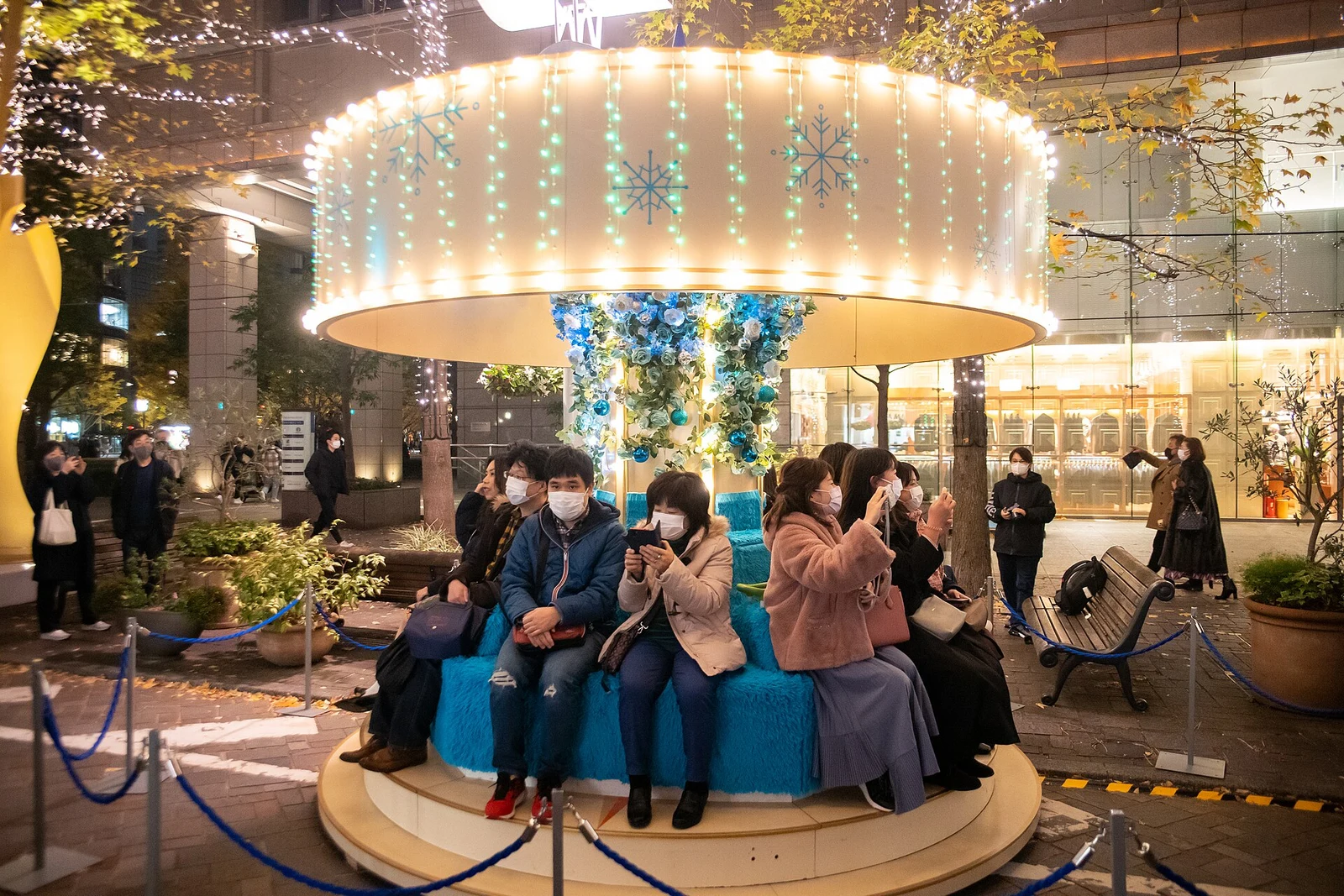
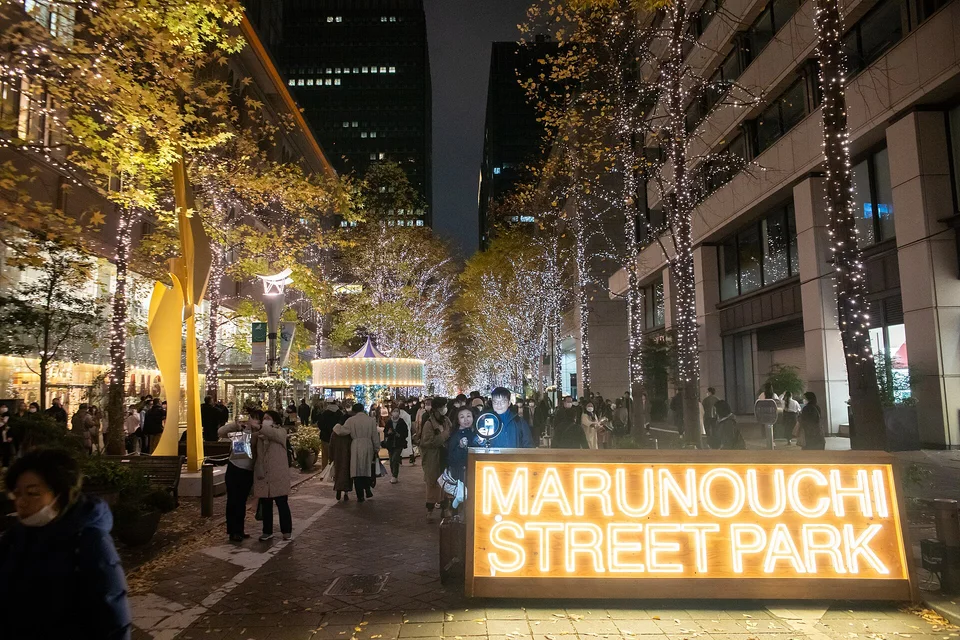
Historic images in this guide show real places in past seasons. Their purpose is to explain the setting and visual character, not to verify 2026 decorations, crowd levels or weather. Compare the image caption’s year with the current programme before expecting a particular tree, colour sequence or installation.
Choose a short version before leaving your hotel
With only an hour of usable outdoor time, do not begin the full Omotesando–Shibuya route. Select the compact Roppongi core, or part of Marunouchi near the station you can reach most easily. The published route ranges are planning allowances, not a promise that every connection and photo stop fits into their lower limit. A shorter evening is especially sensible after a flight or a long day of sightseeing.
For a two-hour evening with dinner afterward, start on the Marunouchi side of Tokyo Station and progress south only while the group remains comfortable. Hibiya is a possible finish, not an obligation. If you prefer Roppongi, keep the dinner reservation in the same area and check the actual restaurant entrance before choosing how far to walk down Keyakizaka. A map’s straight line can hide stairs, crossings and a change of level.
For a longer walk, use Omotesando and Shibuya during their planned shared dates, December 11–25, after confirming the final daily announcements. Treat Harajuku as a decision point: continue toward the designated Blue Cave area only if time, weather and energy permit. The lake of blue light seen in a video is a visual effect within a specific event area, not an instruction to cross all of Yoyogi Park. Having a clear place to stop makes the longer route easier to enjoy.
Route 1: Tokyo Station → Naka-dori → Hibiya
.jpg)
Start on the Marunouchi side of Tokyo Station. Take a moment to orient yourself in the station forecourt, then head towards Marunouchi Naka-dori and follow the lit street south towards Yurakucho. The key experience is the sequence of trees and building fronts rather than a race to one photograph. Pause where the pavement widens, and cross side streets deliberately.
Continue to Hibiya Naka-dori and Tokyo Midtown Hibiya’s Step Square. The organizer lists the square, surrounding street and sixth-floor Park View Garden as programme areas. The rooftop garden is an optional detour: check its access and current conditions rather than treating it as essential. Return through Hibiya Station or continue a short distance to Yurakucho according to your rail line.
For a shorter version, finish at Yurakucho after the Marunouchi section. For a slower version, have dinner between the two districts and visit Hibiya afterwards within its confirmed hours. The main Hibiya Christmas tree ends on 25 December even though other lighting continues into February. A January walk can still be worthwhile, but it is a different programme.
Route 2: one compact circuit around the Hills
Start at Roppongi Station and follow the signed pedestrian approach into Roppongi Hills. Use the plazas to orient yourself before heading towards Keyakizaka. The illuminated avenue is a slope, so decide whether your group would prefer to descend first and return by the most suitable signed path. Do not assume the shortest-looking stairway is the best route for everyone.
Spend most of your time on the street-level view, then add 66 Plaza or the Mori Garden area if access and time allow. The 2026 announcement includes these areas, but their exact operating arrangements should be checked close to the visit. This walk does not require Tokyo City View or a museum ticket. If you choose a paid attraction, add both its admission and a separate time allowance.
A Tokyo Tower view from the district can be a bonus, not a reason to wait in the roadway or insist on one crowded bridge position. Finish near Roppongi Station after a meal or a final short loop. Tokyo Midtown is a different complex: it can be a separate evening, but it is not needed to make this compact route complete.
Route 3: the avenue first, then an optional blue-lit second half
Begin near Omotesando Station and walk along the main avenue towards Meiji-jingumae and Harajuku. This first half already makes a satisfying outing for people who want shops and street illuminations. Use ordinary crossings, keep station entrances clear and let the group stop in wider areas rather than on the narrowest stretch of pavement.
If the dates overlap and the organizer confirms opening, continue towards the Yoyogi Park Keyaki Namiki event area, then follow the appropriate pedestrian route towards Koen-dori and Shibuya. The blue display is associated with this specific event area, not every path inside Yoyogi Park. Follow the current entrance, direction-of-travel and exit signs; an old photograph is not a route map.
The complete walk is the longest of the three. End at Harajuku after the avenue if energy or weather suggests it. Alternatively, visit the blue event from Shibuya on a different night. The planned 11–25 December overlap is useful for choosing dates, but daily hours and access instructions still need the final event announcement. Do not set a timed dinner around an unconfirmed lighting hour.
Is everything in these walks free?
Viewing the public street and plaza displays is the free part. Transport, food, shopping, observation decks, museums and any separately ticketed experience are outside that scope.
Can I do all three routes in one night?
It is possible to move between districts, but transfers reduce the time spent enjoying the lights. Choose one route, or split the Omotesando and Shibuya halves across evenings.
Which route works after 25 December?
Marunouchi and parts of Hibiya have confirmed illumination seasons into February 2027. Christmas-specific trees and programmes can finish earlier; Hibiya’s main tree ends on 25 December.
What is the best date for Omotesando and Blue Cave together?
The metropolitan 2026 guide indicates an intended overlap of 11–25 December. Omotesando is listed as planned, and final daily hours should be confirmed with the operators.
Are these verified step-free routes?
No. They are neighbourhood planning routes. Check station elevators, crossings, slopes and any building-level access for your needs; omit the upper garden or a difficult segment where necessary.
Do the walking times include dinner?
No. They are approximate editorial allowances for a slow walk and photographs, excluding a full meal, shopping and significant queues.