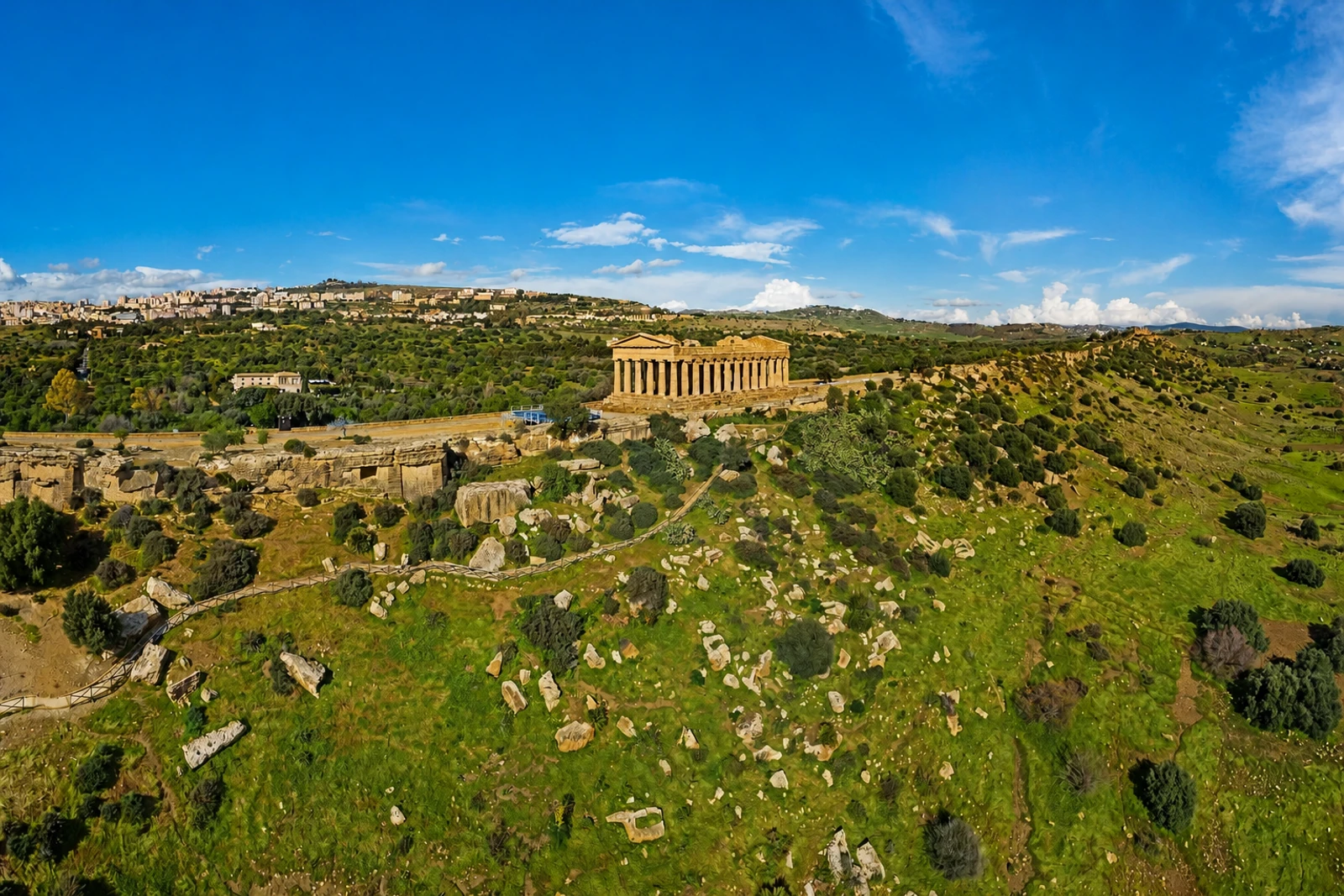
Agrigento: Doric temples within an ancient Greek colonial landscape
Agrigento belongs because its UNESCO property preserves the extensive territory of an ancient Greek polis, not simply a row of temples. Founded as a Greek colony in the sixth century B.C., it became a leading Mediterranean city. The boundary extends from the Rupe Atenea and original acropolis to the sacred hill, extramural necropolis, residential areas, underground aqueducts and land containing unexcavated remains. That wider setting is essential to understanding the site’s colonial urban character.
The Doric temples are the most immediately recognisable evidence, but their significance is strengthened by what surrounds them. Much of the ancient town remains beneath fields and orchards, and selected excavations reveal the later Hellenistic and Roman city as well as burial practices of early Christian inhabitants. Some street lines and entrances continued in use from the medieval period. Unlike Aquileia, where Roman port installations and a basilica anchor the interpretation, Agrigento presents Greek architecture in an unusually preserved landscape that was not broadly overlaid by later buildings or adapted to later cults.
The property’s authenticity is described as outstanding, and its archaeological structures are in good condition, although land instability remains an issue. A regional Archaeological and Landscape Park manages preservation, access and presentation of the ancient urban organisation. The Park Plan is intended to make streets, roads and thematic routes more legible, including parts still awaiting excavation. Current site boundaries and construction controls are therefore part of the heritage story, not incidental administrative details.