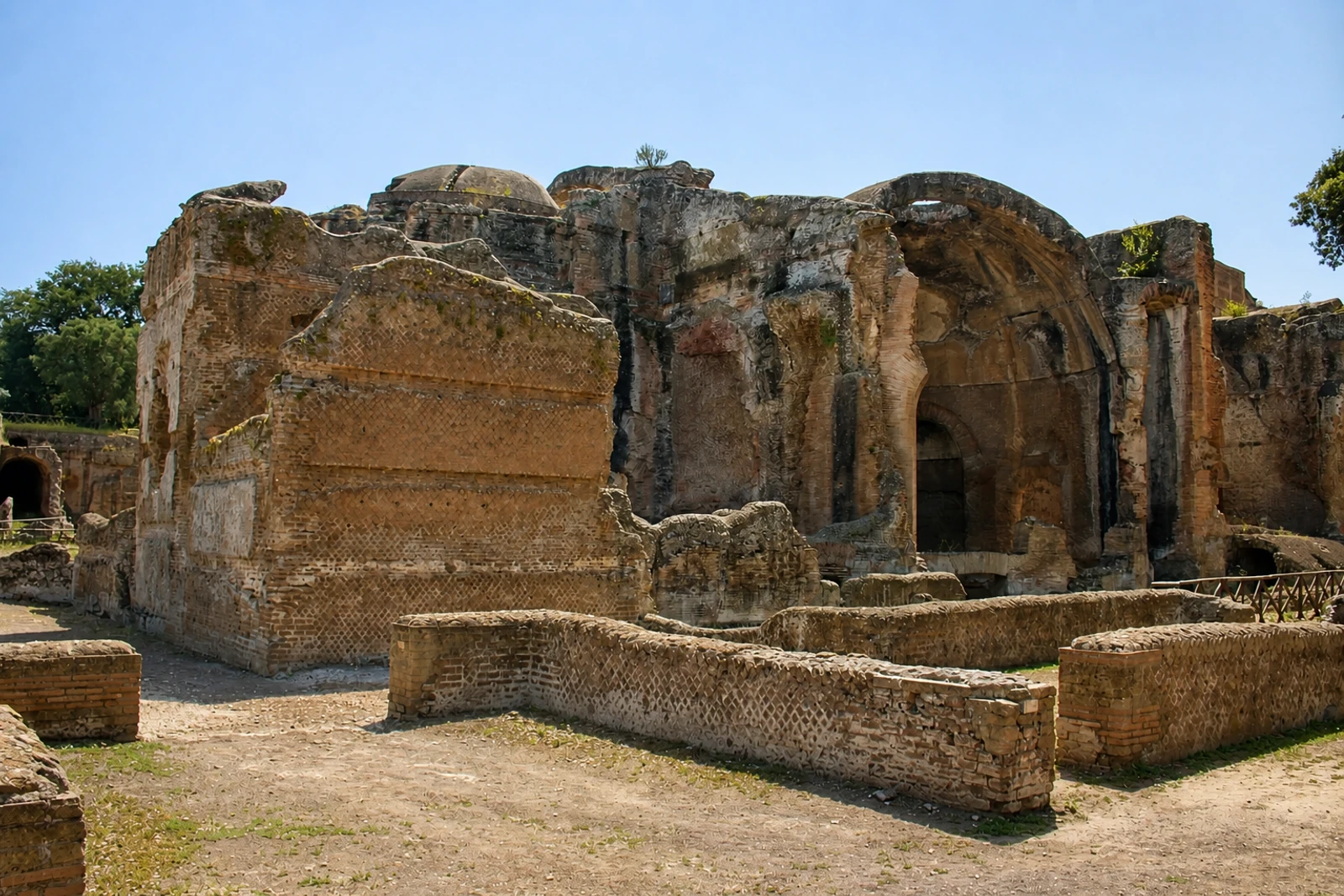
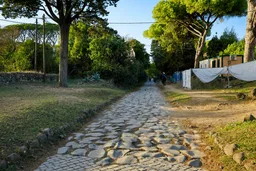
Hadrian's Villa (Villa Adriana) is mapped at Largo Marguerite Yourcenar, 1, 00019 Tivoli RM.
Regional transport plus local bus/taxi; a car-free day trip is possible but less simple than Ostia. Separate VILLÆ admission; verify ticket options, entrances, and seasonal hours. The official operator or public heritage source was checked on Aug 25, 2026; hours, prices, access routes, and closures remain variable and must be rechecked before travel.
Practical details
Known for
day trip, UNESCO, Hadrian
Last verified
2026-08-25
Why this place belongs on the map
Ancient Roman Sites in Rome: Interactive Map of Ruins & Landmarks
Villa Adriana: an imperial villa that works as a Tivoli day trip
Villa Adriana is the Tivoli entry in this Rome-focused map, with the exact address Largo Marguerite Yourcenar, 1, 00019 Tivoli RM. It belongs because it gives the map a separate imperial-villa option beyond the Appian Park setting. It should not be confused with Villa dei Quintili: the two are different Places, in different visitor contexts, with different transport and admission arrangements.
The suggested visit duration is 3–4 hours. Reaching it involves regional transport plus a local bus or taxi. A car-free day trip is possible, but the supplied planning note describes it as less simple than Ostia. That distinction helps visitors decide whether the site fits a day built around a more involved outward journey.
Villa Adriana has separate VILLÆ admission. Ticket options, entrances, and seasonal hours should be checked before travel. Choose this Place for the Tivoli villa specifically, rather than treating it as an extension of central Rome or as a substitute for an Appian Park stop. Its regional setting is part of the planning identity represented by the pin.
UNESCO World Heritage Sites in Italy
Villa Adriana, Tivoli: Hadrian’s planned world in the hills
Villa Adriana belongs on this map as a Roman imperial complex conceived on a scale and with an ambition unlike the Renaissance garden at nearby Villa d’Este. Built as a retreat from Rome between 117 and 138 AD, it was created for Emperor Hadrian and arranged as an ideal city. The remains of around 30 buildings extend across 120 hectares of the Tiburtine Hills, bringing together residential, recreational, garden and water features.
Its apparent lack of order is misleading. The complex includes distinct groups of buildings, including the so-called Greek Theatre and Temple of Cnidian Aphrodite; the emperor’s central buildings; baths; and structures such as the Lily Pond, Roccabruna Tower and Academy. The Golden Square has a vast peristyle with alternating cipollino marble and Egyptian granite columns. The circular Maritime Theatre contains an Ionic marble peristyle around an artificial island and miniature villa.
Villa Adriana is easily confused with Villa d’Este because both are in Tivoli, but their identities are separate. Hadrian’s villa is an Early Roman imperial survival whose architecture draws together Egyptian, Greek and Roman material cultures. Its underground cryptoportici and galleries, gardens including the Pecile, monumental nymphaea, reflective pools and servants’ dwellings show the complexity of the whole site. After centuries of damage and neglect, its rediscovery in 1461 contributed to renewed study of classical architecture and influenced later architects and designers. Inscribed in 1999 as a cultural property under criteria (i), (ii) and (iii), it is a place to examine imperial planning, cultural synthesis and architectural afterlife.
Hadrian's Villa is a visitor-facing imperial villa in Tivoli, selected for a Rome-focused map rather than a world-wide Roman Empire inventory. Allow 3–4 hours.
Hadrian's Villa (Villa Adriana) is mapped at Largo Marguerite Yourcenar, 1, 00019 Tivoli RM.
Regional transport plus local bus/taxi; a car-free day trip is possible but less simple than Ostia. Separate VILLÆ admission; verify ticket options, entrances, and seasonal hours. The official operator or public heritage source was checked on Aug 25, 2026; hours, prices, access routes, and closures remain variable and must be rechecked before travel.
Practical details
Known for
day trip, UNESCO, Hadrian
Last verified
2026-08-25
Why this place belongs on the map
Ancient Roman Sites in Rome: Interactive Map of Ruins & Landmarks
Villa Adriana: an imperial villa that works as a Tivoli day trip
Villa Adriana is the Tivoli entry in this Rome-focused map, with the exact address Largo Marguerite Yourcenar, 1, 00019 Tivoli RM. It belongs because it gives the map a separate imperial-villa option beyond the Appian Park setting. It should not be confused with Villa dei Quintili: the two are different Places, in different visitor contexts, with different transport and admission arrangements.
The suggested visit duration is 3–4 hours. Reaching it involves regional transport plus a local bus or taxi. A car-free day trip is possible, but the supplied planning note describes it as less simple than Ostia. That distinction helps visitors decide whether the site fits a day built around a more involved outward journey.
Villa Adriana has separate VILLÆ admission. Ticket options, entrances, and seasonal hours should be checked before travel. Choose this Place for the Tivoli villa specifically, rather than treating it as an extension of central Rome or as a substitute for an Appian Park stop. Its regional setting is part of the planning identity represented by the pin.
UNESCO World Heritage Sites in Italy
Villa Adriana, Tivoli: Hadrian’s planned world in the hills
Villa Adriana belongs on this map as a Roman imperial complex conceived on a scale and with an ambition unlike the Renaissance garden at nearby Villa d’Este. Built as a retreat from Rome between 117 and 138 AD, it was created for Emperor Hadrian and arranged as an ideal city. The remains of around 30 buildings extend across 120 hectares of the Tiburtine Hills, bringing together residential, recreational, garden and water features.
Its apparent lack of order is misleading. The complex includes distinct groups of buildings, including the so-called Greek Theatre and Temple of Cnidian Aphrodite; the emperor’s central buildings; baths; and structures such as the Lily Pond, Roccabruna Tower and Academy. The Golden Square has a vast peristyle with alternating cipollino marble and Egyptian granite columns. The circular Maritime Theatre contains an Ionic marble peristyle around an artificial island and miniature villa.
Villa Adriana is easily confused with Villa d’Este because both are in Tivoli, but their identities are separate. Hadrian’s villa is an Early Roman imperial survival whose architecture draws together Egyptian, Greek and Roman material cultures. Its underground cryptoportici and galleries, gardens including the Pecile, monumental nymphaea, reflective pools and servants’ dwellings show the complexity of the whole site. After centuries of damage and neglect, its rediscovery in 1461 contributed to renewed study of classical architecture and influenced later architects and designers. Inscribed in 1999 as a cultural property under criteria (i), (ii) and (iii), it is a place to examine imperial planning, cultural synthesis and architectural afterlife.