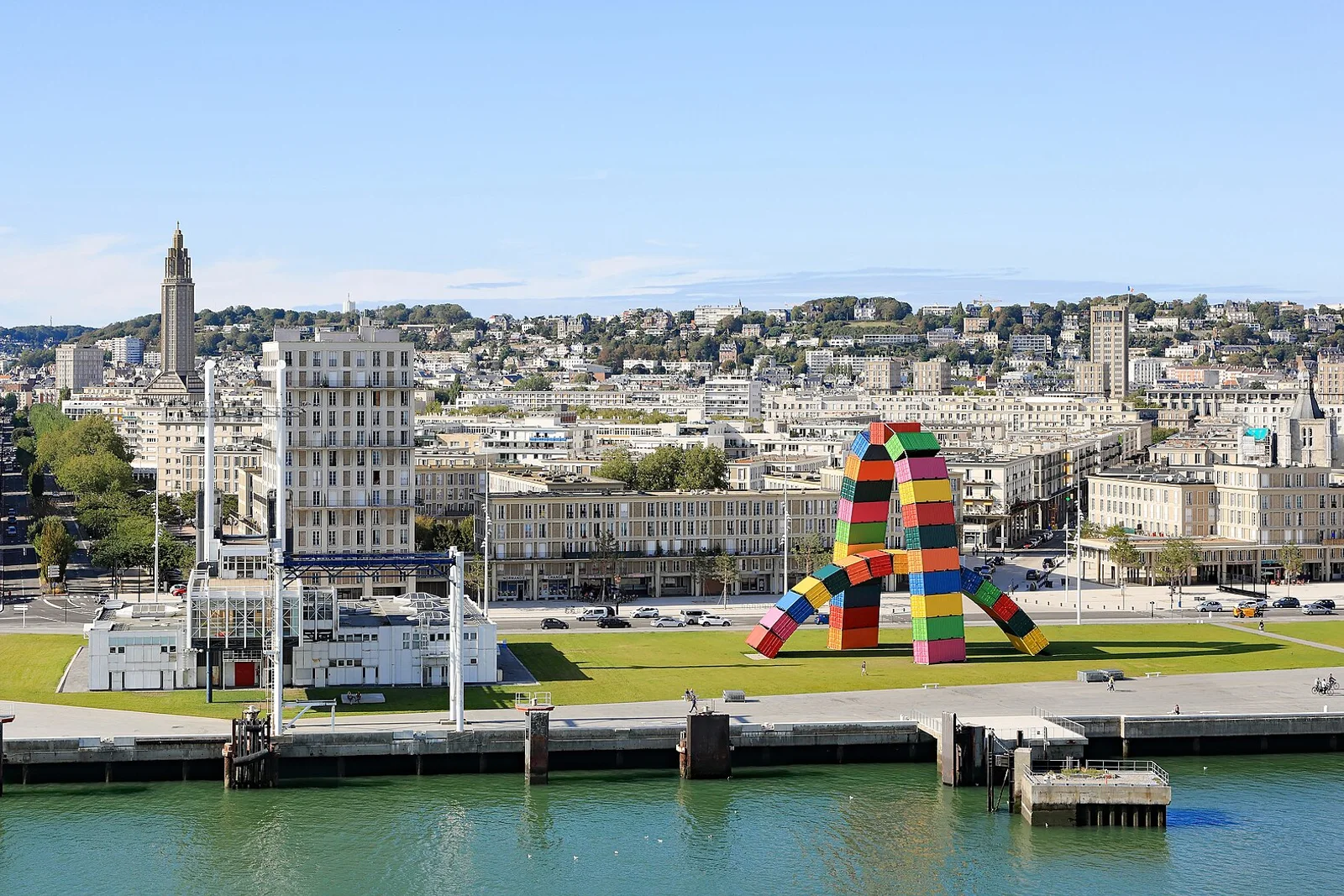
Le Havre: modern reconstruction as an urban ensemble
Le Havre belongs for a reason that is easy to miss when looking only for older monuments: its World Heritage value is concentrated in a coherent post-war reconstruction. Severely bombed during the Second World War, the city centre was rebuilt from 1945 to 1964 by a team headed by Auguste Perret. UNESCO classifies it as cultural under criteria (ii)(iv), recognising the integration of urban traditions with modern architecture, technology and planning.
The property is not simply a collection of individual concrete buildings. Its 133-hectare urban ensemble includes principal axes, squares, groups of buildings and ordinary residential fabric—streets, passages and inner blocks—created within the reconstruction framework. It also incorporates fragments of earlier fabric, buildings that survived destruction, the île Saint-François rebuilt by regional architects, and later structures considered inseparable from the rebuilt city.
The details to read are the organising devices. Avenue Foch provides the principal west–east axis from Porte Océane towards Saint-Roch square and the Hôtel de Ville; Boulevard François Ier crosses it at a 45-degree angle. Porte Océane recalls an earlier city gate while serving as a testing ground for construction methods. The Town Hall anchors the scheme with its long façade and tower. Prefabrication, visible reinforced-concrete structure and a 6.24-metre square module give the city order without reducing it to repetition. Le Havre was inscribed in 2005.