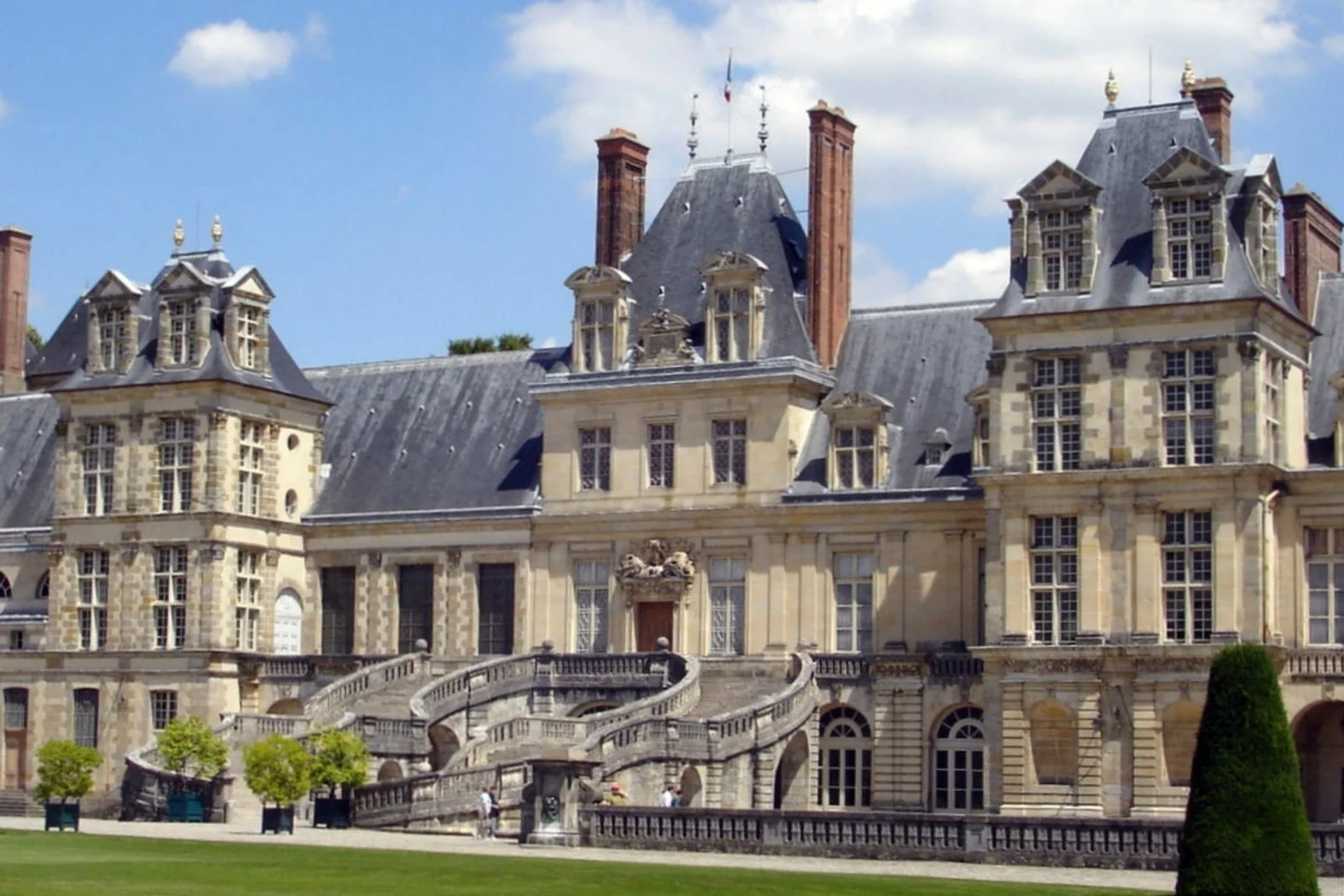
Fontainebleau: a royal residence built as an artistic workshop
Fontainebleau belongs on this map because it shows how a royal residence could become a centre for artistic exchange, not merely a sequence of rooms. Used by French kings from the 12th century, the hunting lodge was transformed and enlarged under François I, who imagined a “New Rome”. The resulting palace stands in the forest of the Île-de-France and combines Italianate design with French Renaissance traditions. Its UNESCO significance is cultural: the architecture and decoration influenced the evolution of art in France and Europe.
Its identity is easier to distinguish from Versailles by its irregular accumulation. The present complex has five courtyards arranged irregularly, surrounded by buildings and gardens that bear the marks of successive rulers and styles. Look for the François I gallery’s painted and stucco decoration, the artistic connections of Rosso Fiorentino, Primaticcio and their collaborators, and the traces of later generations often known through drawings and engravings. The Grand Jardin, with its four flowerbeds and flower-bordered lawn, records another layer of change, including redesign associated with Le Nôtre. The property remained a royal or imperial residence until the 19th century and is fully protected under the Heritage Code.