Northwest Wales: an industrial landscape from mountain to sea
The Slate Landscape of Northwest Wales belongs because UNESCO recognises an entire industrial landscape, not simply a quarry or a railway. Inscribed in 2021 under cultural criteria (ii) and (iv), it comprises six component parts across the mountains and valleys of the Snowdon massif. Together they show how slate extraction, processing and transport reshaped an agricultural environment during industrialisation, particularly between 1780 and 1914.
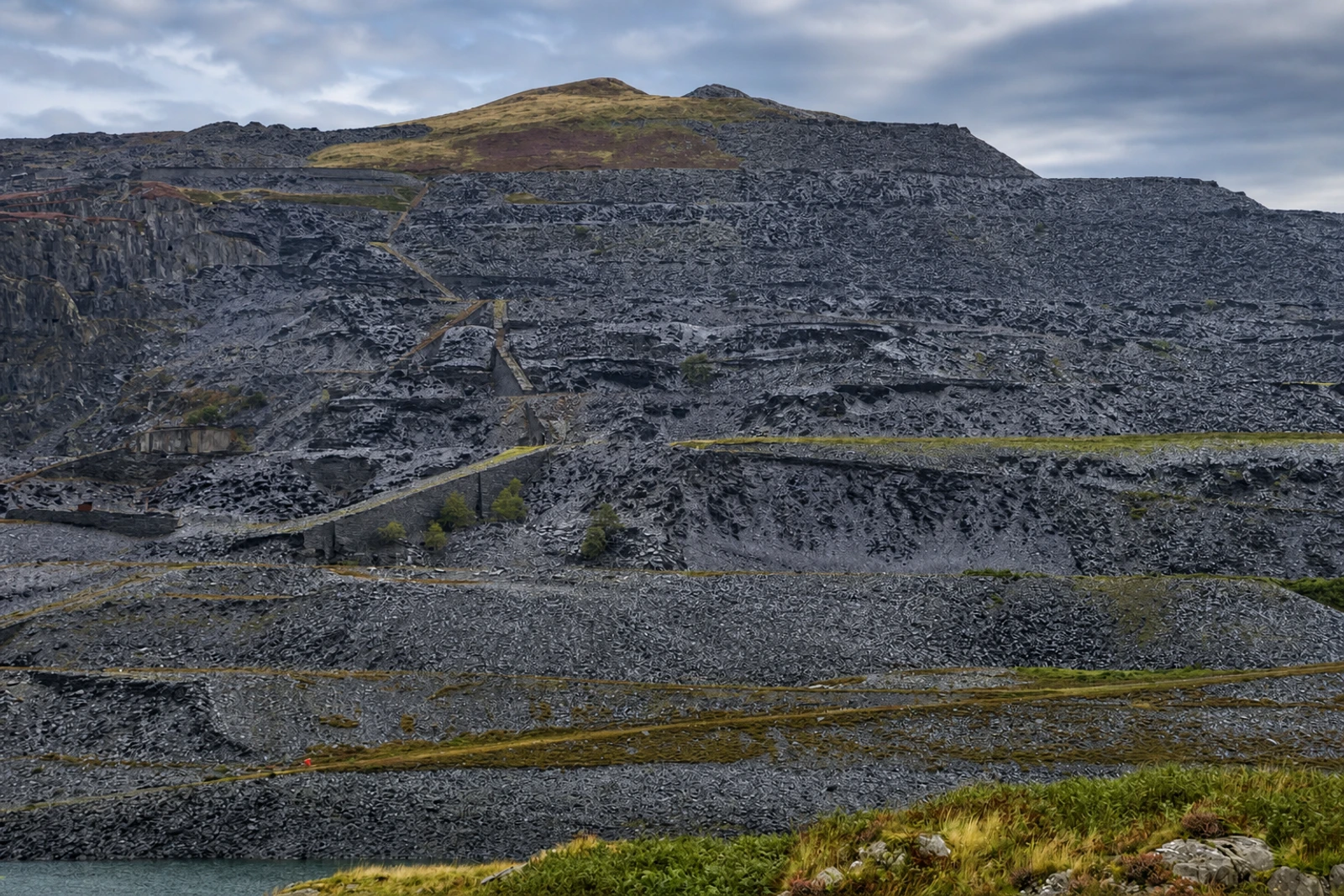
Its scale and connected evidence distinguish it from a conventional industrial museum. Stepped hillside workings, deep pits, underground chambers, cascading tips, water systems and surviving equipment sit alongside settlements, chapels, schools, libraries, grand houses, gardens, ports and railway and road systems. The contrast between industrialists’ estates and workers’ vernacular communities is especially important: the property records both the technology of production and the social world created around it. Welsh slate also travelled outward as material, knowledge and skilled labour, while narrow-gauge railways developed in the massif influenced systems far beyond Wales.
This is a property to explore through selected anchors rather than one complete circuit. Bangor, Blaenau Ffestiniog and Tywyn are the practical rail gateways listed for the map; heritage railways and buses cover selected areas. Allow one to three days according to the components chosen, and check museums, quarries and railway reservations separately. The extra pins identify visit components, not additional UNESCO properties.