Pompeii, Herculaneum and Torre Annunziata: Roman life preserved in contrast
This entry belongs because UNESCO treats seven archaeological components across Pompeii, Herculaneum and Torre Annunziata as one serial property shaped by the eruption of Vesuvius in AD 79. It includes the towns of Pompeii and Herculaneum, the Villa of the Mysteries, the Villa of the Papyri, and Villa A and Villa B at Torre Annunziata. The sites should not be confused with one another: they preserve different scales and types of Roman life.
Pompeii offers the broad urban picture, with an excavated area of 44 hectares, forum, public buildings, baths, theatres, amphitheatre, shops, paved streets and extensive graffiti. Herculaneum is smaller but preserves urban districts, a seafront, upper floors, wooden furniture and carbonized foodstuffs through the different effects of pyroclastic material. Large parts of ancient Herculaneum remain beneath the modern town and are mostly outside the World Heritage property. These contrasts are more useful than treating both towns as interchangeable volcanic ruins.
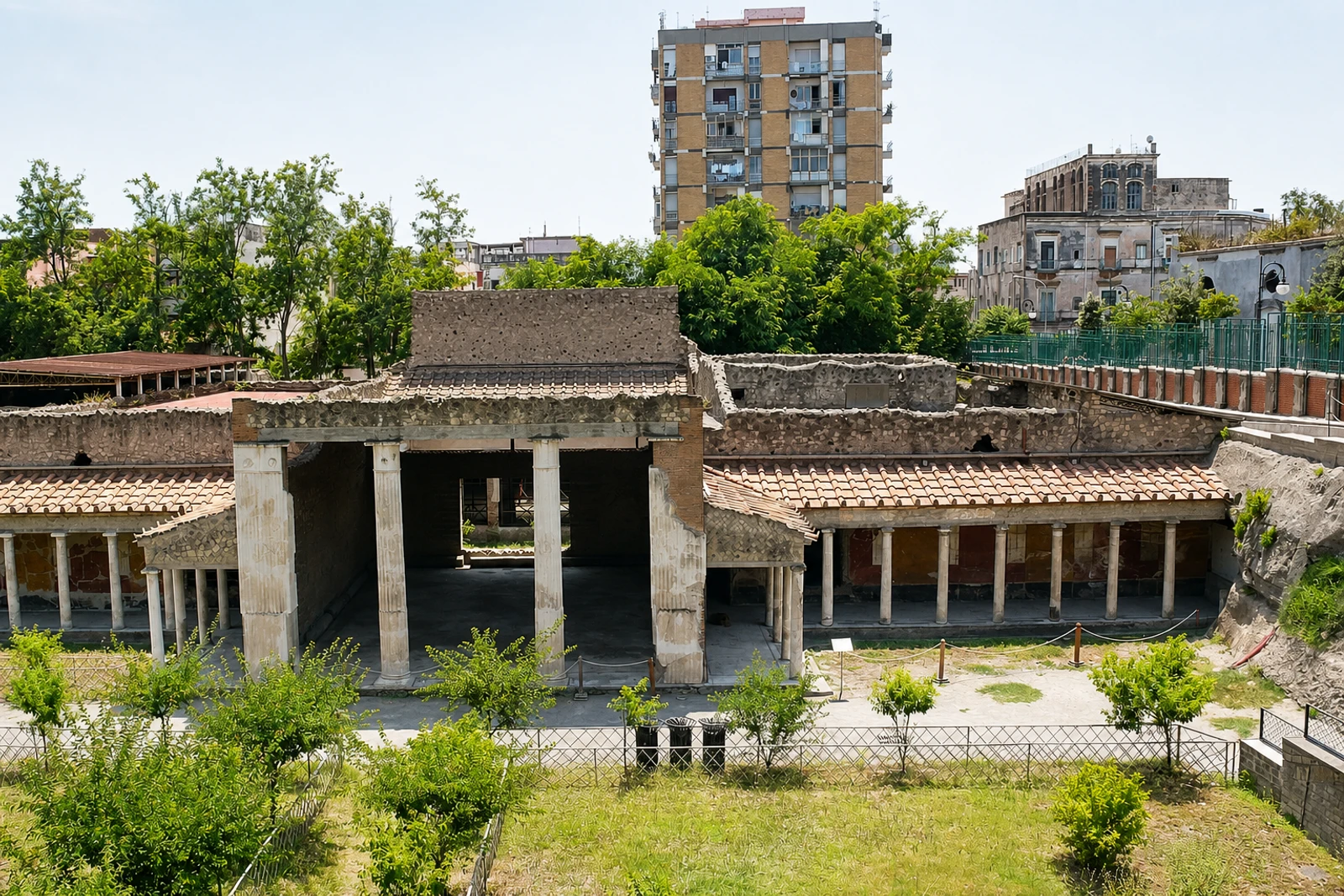
The villas add elite and commercial dimensions. The Villa of the Mysteries is known for its triclinium paintings depicting Dionysian initiation rites; Villa A at Torre Annunziata contains illusionistic frescoes of doors, colonnades and gardens; Villa B preserves storage and trading spaces associated especially with wine. Repairs and alterations made before the eruption record owners adapting to seismic, environmental and economic change. The property’s meaning therefore spans public life, domestic architecture, luxury, commerce and catastrophe.