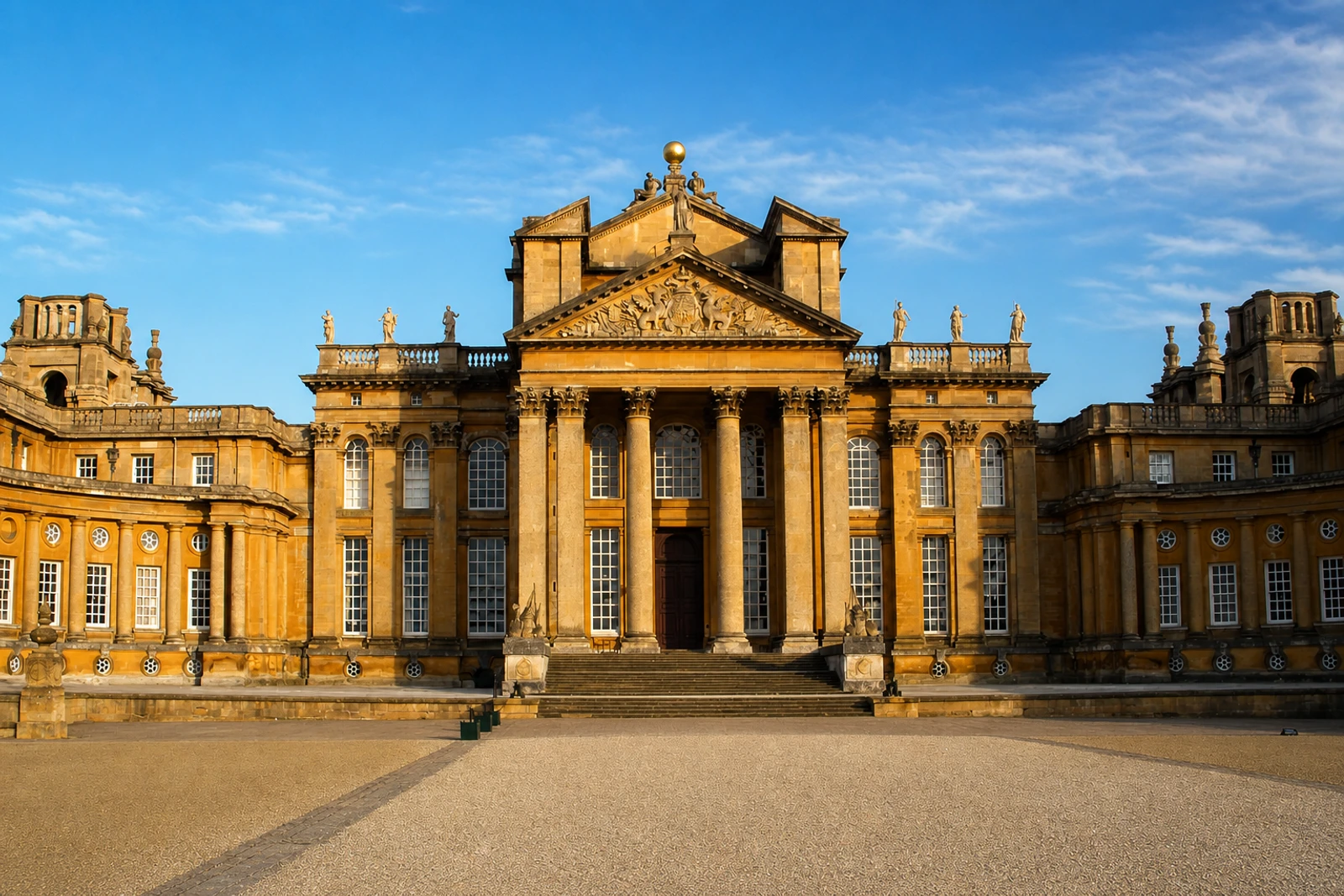
Blenheim Palace: power expressed through house and park
Blenheim is the right choice when the UNESCO story is centred on a grand residence whose architecture and landscape were conceived together. The English nation presented it to John Churchill, first Duke of Marlborough, after his 1704 victory over French and Bavarian troops. John Vanbrugh designed the palace, with work by Nicholas Hawksmoor, and the building created an 18th-century princely setting rather than an ordinary country house. Its association with Sir Winston Churchill adds another recognised layer without replacing the property’s architectural focus.
The palace’s distinction lies in the relationship between structure, decoration and park. Built between 1705 and 1722, it retains an eclectic style and a return to national sources that UNESCO connects with the beginnings of the English Romantic movement. The Saloon’s decoration by Louis Laguerre recalls Marlborough’s position as an English aristocrat and Prince of the Germanic Holy Roman Empire. Inside, original fittings and furnishings contribute to the surviving form and design.
Outside, Vanbrugh regulated the River Glyme, while Lancelot “Capability” Brown reshaped the park from 1761 and created two lakes. The large walled landscape park still preserves visual links among gates, buildings, villages and surrounding land, with veteran trees and traces of an earlier Roman and medieval landscape. Allow three to five hours, approach from Oxford or Oxford Parkway by the S7, and consider the wall, palace-park relationship and landscape views as part of the UNESCO property. Advance admission is recommended.