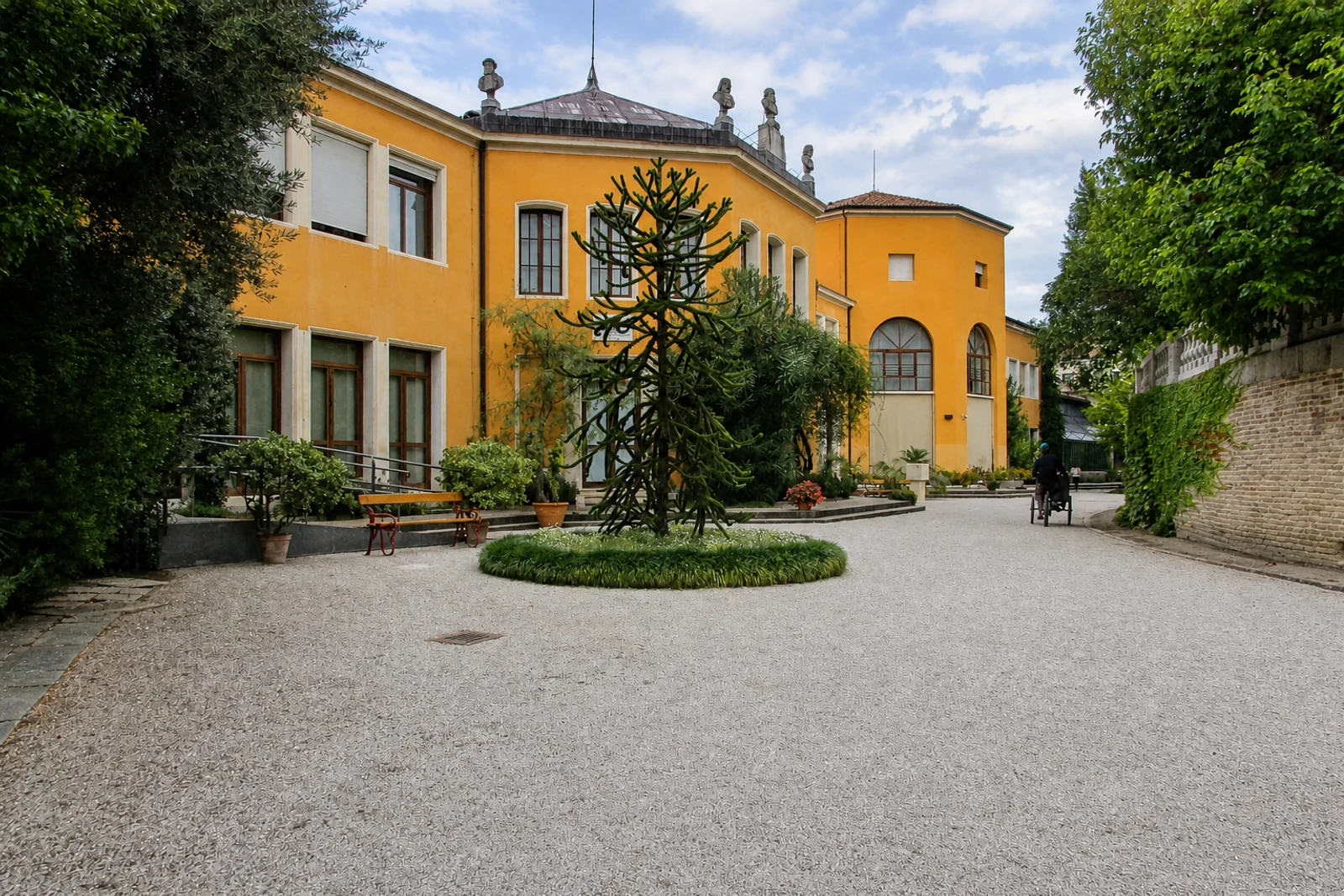
Padua’s Orto Botanico: the garden that made science spatial
Padua belongs because its Botanical Garden is a purpose-built scientific institution whose original function continues. Created in 1545, it is the world’s first university botanical garden and the oldest surviving example of its type. UNESCO values both its influence on botanical gardens across Italy and Europe and its testimony to the exchange of plants, ideas and knowledge. This is therefore a heritage site of science and education as much as a historic garden.
Its plan makes the distinction visible. A circular central plot symbolises the world and is surrounded by a ring of water representing the ocean. A large inscribed square within the circle is divided into four units by paths aligned with the cardinal directions. Later additions—ornamental entrances, balustrades, pumping installations and greenhouses—did not erase the original layout. The garden’s geometry separates it from Caserta’s theatrical landscape design and from the cultivated settings of the archaeological properties.
Look for the relationship between structure and collection. More than 6,000 species are arranged through systematic, utilitarian, ecological-environmental and thematic criteria. The garden also holds a library of more than 50,000 volumes and manuscripts and an herbarium described as the second most extensive in Italy. Its work has contributed to botany, medicine, ecology and pharmacy, while continuous research, teaching and scientific dissemination preserve its original purpose. Later restoration respected original characteristics and materials, and the garden retains high structural and functional continuity.