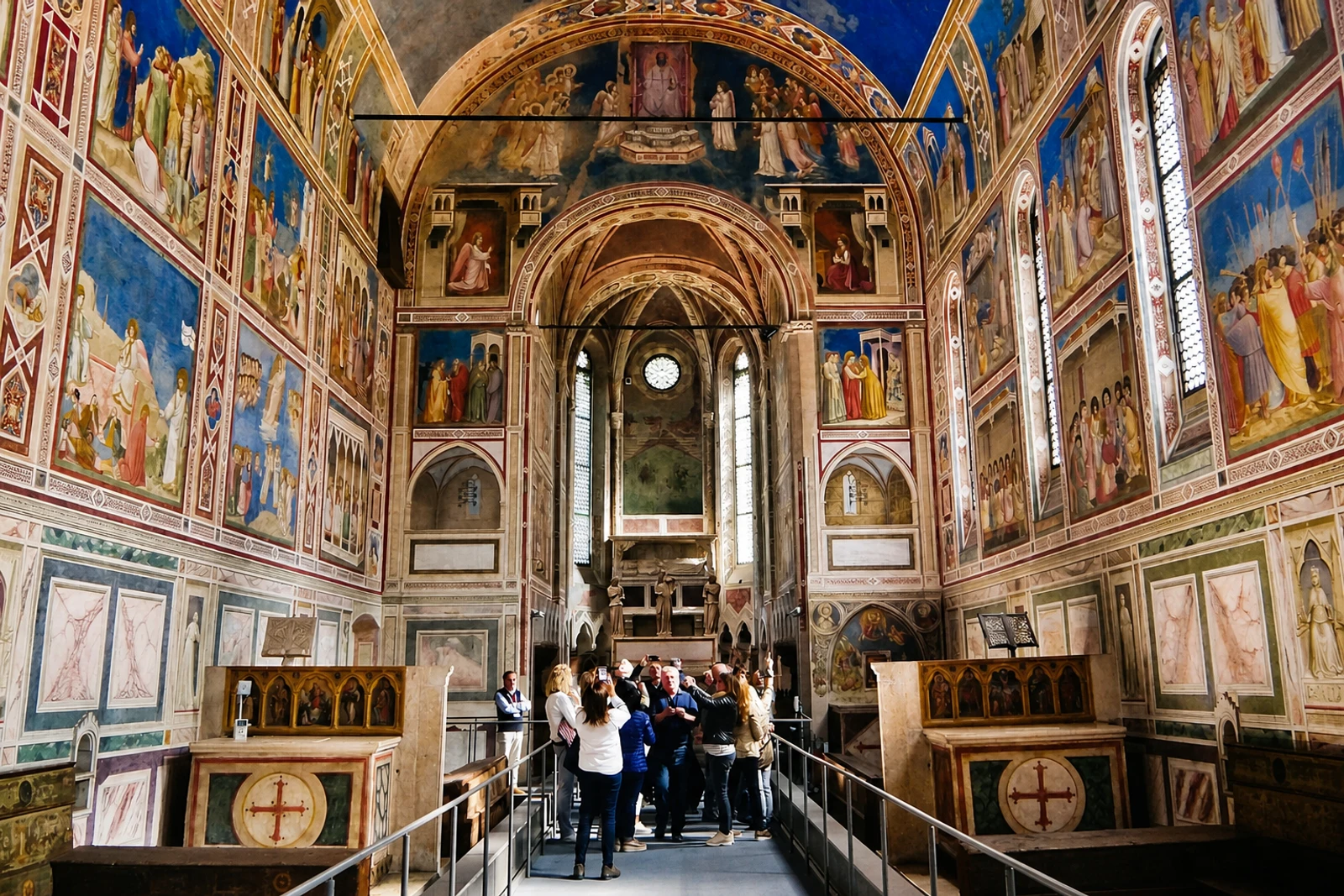
Padua’s fresco cycles: a city-wide experiment in pictorial space
Padua’s fourteenth-century fresco cycles belongs because UNESCO recognises a connected artistic sequence rather than one chapel alone. Inscribed in 2021 under criterion (ii), the serial cultural property comprises eight religious and secular building complexes grouped into four component parts within Padua’s historic walled city. The frescoes were painted between 1302 and 1397 for different patrons and in buildings with different functions.
Giotto’s Scrovegni Chapel is one part of the story, alongside cycles associated with artists including Guariento di Arpo, Giusto de’ Menabuoi, Altichiero da Zevio, Jacopo Avanzi and Jacopo da Verona. Their work shows experiments in perspective, trompe-l’oeil and the representation of individual feelings and emotions. Patrons increasingly appeared within the scenes, and sacred art could also express the prestige and power of ruling authorities and noble families.
The property is especially valuable for comparison. Its cycles maintain a unity of style and content despite varied authorship, patronage and setting, allowing visitors to follow an exchange of ideas among science, literature and visual art in Padua’s pre-humanist climate. That makes the property different from a single-artist visit or a simple Giotto destination. The frescoes remain inseparable from their architectural interiors, painted supports, plaster, pigments and binding agents. The four component parts should therefore be checked individually: conservation work and ownership involve Padua City Council, the Ministry for Cultural Heritage and Activities, and the University of Padua.