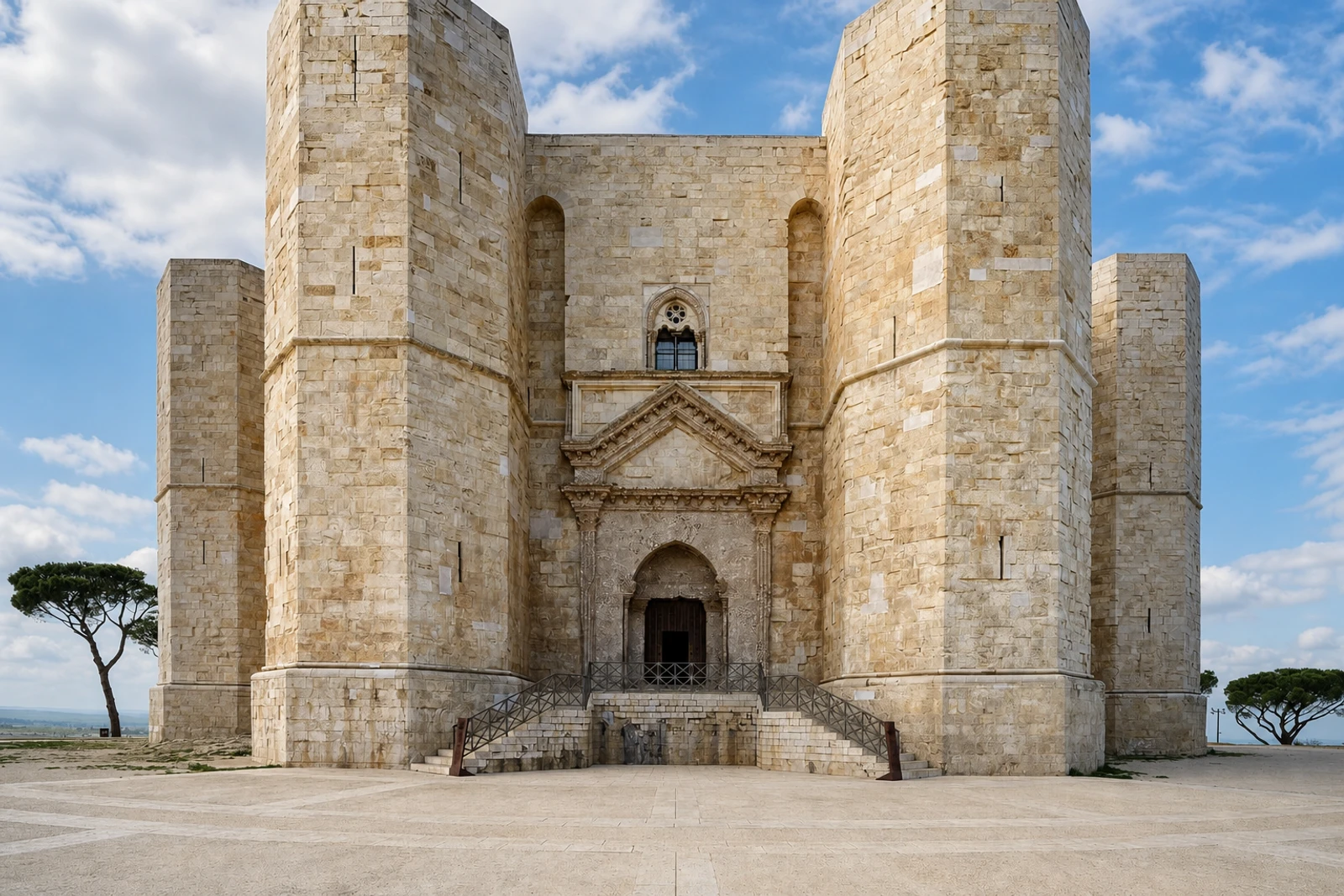
Castel del Monte: the octagonal vision of Frederick II
Castel del Monte belongs on this map because it turns medieval architecture into a study of geometry, symbolism and cultural connection. Built by Emperor Frederick II near Andria and completed in 1240, it stands on a rocky hill above the Murgia countryside near the Adriatic Sea. The setting is not incidental: UNESCO identifies the location, the regular plan and the mathematical and astronomical precision as expressions of the founder’s intellectual and cultural vision.
Its defining form is an octagon with an octagonal tower at every angle. That disciplined outline distinguishes it from more conventional castle imagery and makes the building’s formal order central to understanding it. UNESCO also describes the monument as a blend of classical antiquity, the Islamic Orient and north European Cistercian Gothic. Eastern influence is visible in the innovative hydraulic installation associated with Frederick II’s bathing customs, while the wider significance lies in how traditions from northern Europe, the Muslim world and classical antiquity meet in one creation.
The property is worth noticing as both monument and setting. It has undergone almost no significant structural alteration, and its original octagonal form, interior design and exterior limestone construction remain. The interior’s marble and mosaic decoration has deteriorated or been removed, so the preserved shell and the losses belong to the same conservation story. The protected landscape around the solitary castle is part of the property, preventing the common mistake of treating the building as detached from its hilltop context. Castel del Monte was inscribed as a cultural property in 1996 under criteria (i), (ii) and (iii).