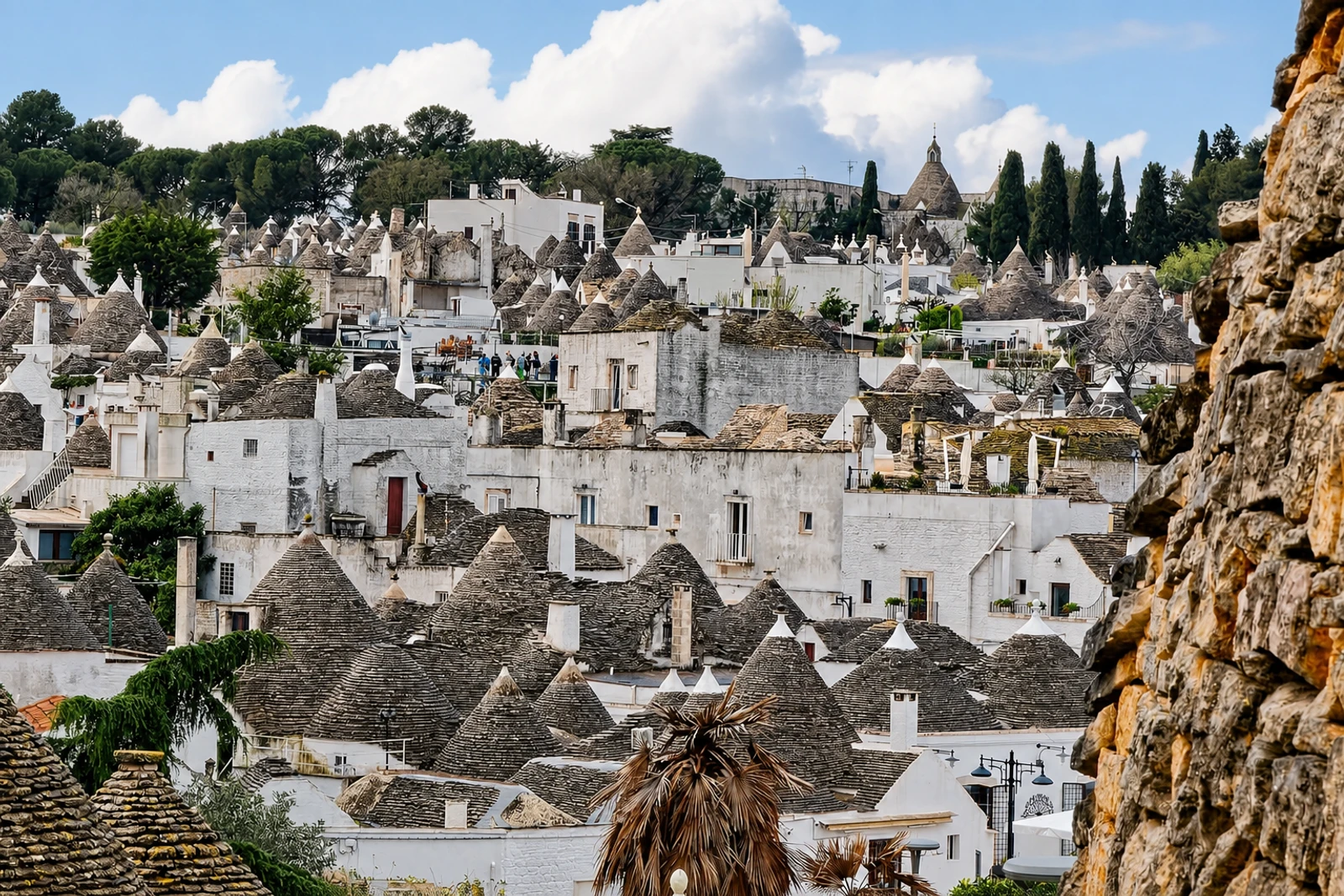
The Trulli of Alberobello: dry-stone homes and a living urban landscape
The Trulli of Alberobello belongs for the precision of its building tradition and the concentration of its surviving settlement. Inscribed in 1996 under criteria (iii), (iv) and (v), the property covers six land parcels and 11 hectares in Puglia. More than 1,500 trulli are concentrated in Rione Monti and Aia Piccola, with four additional locations including Casa d’Amore, Piazza del Mercato, Museo Storico and Trullo Sovrano.
What distinguishes Alberobello from scattered rural examples across the Itria Valley is the extent, homogeneity and continued inhabitation of its urban landscape. A trullo is generally a rectangular dry-stone dwelling with whitewashed walls, a double skin and rubble core, built without mortar or cement. Its roof may be pyramidal, domed or conical, using an inner layer of wedge-shaped stone and an outer layer of corbelled limestone slabs called chianche or chiancarelle. Recessed fireplaces and alcoves, small windows and thick walls reveal how construction shaped domestic space.
Notice the practical intelligence within the decorative form. Projecting eaves divert rainwater through a channelled slab into a cistern below, while simple squinches bridge the rectangular walls and circular or oval roof. White-ash markings and pinnacles may carry mythological or religious associations. The settlement grew from rural occupation into the villages of Monti and Aia Piccola, and the property’s significance rests on the survival of this building method as an inhabited Historic Urban Landscape.