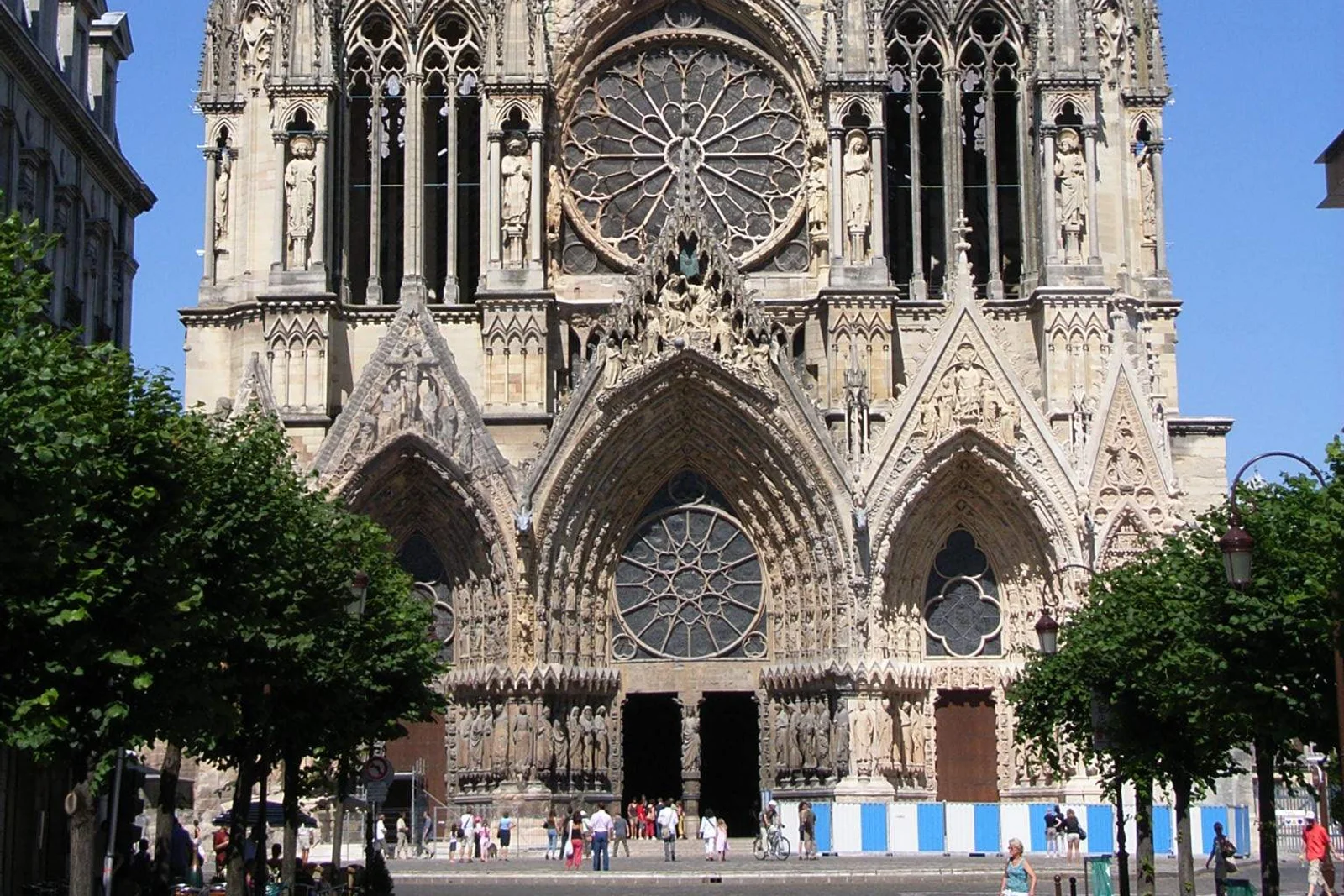
Reims: Gothic art and the geography of coronation
This UNESCO property belongs because it is a connected coronation ensemble rather than Notre-Dame Cathedral alone. The cathedral, the Palace of Tau and the former Abbey of Saint-Rémi are closely tied to the French monarchy and to the ceremonial relationship between sacred function and public authority. The cathedral itself is a major Gothic achievement, where 13th-century architectural techniques and sculptural decoration form one composition rather than separate layers of ornament.
Its distinction from Chartres is especially useful. Chartres is presented as a highly unified and complete expression of early Gothic religious architecture; Reims adds the spaces and rituals surrounding royal coronation. The adjoining Palace of Tau preserves the memory of the ceremony through its Palatine Chapel and banquet hall, while its Musée de l’Oeuvre houses treasures and artworks connected with coronations. The former Royal Benedictine Abbey of Saint-Rémi brings another architectural and ritual dimension.
Notice the cathedral’s western-facade sculpture, stained glass and the traces of its ceremonial role. The abbey retains a 9th-century nave, Romanesque sculpture in its chapter house and architecture of the 18th century, while the palace includes a 17th-century façade. Parts of the ensemble were badly damaged during the First World War and restored, so the present property combines continuity with visible layers of conservation and reconstruction.