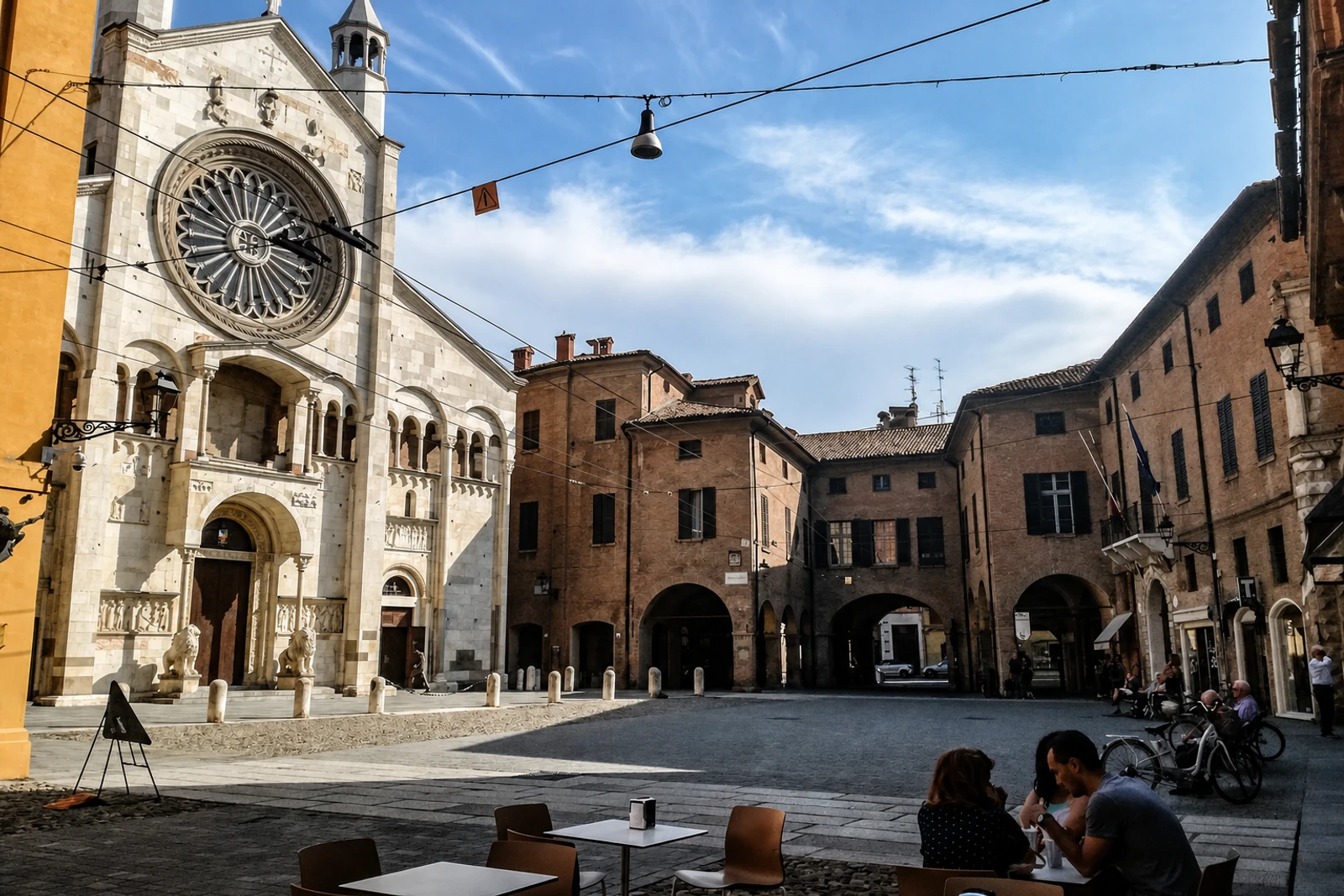
Modena: Romanesque art in a civic square
Modena belongs here as a complete medieval urban ensemble, not simply as a cathedral visit. The World Heritage property brings together the cathedral, Torre Civica or Ghirlandina, Piazza Grande and associated civic and religious buildings in the medieval centre along the historic Via Emilia. The relatively compact boundary makes the relationship between worship, civic authority and public space especially clear.
The cathedral was begun in 1099 by the architect Lanfranco to replace an early Christian basilica, and it contains the remains of Saint Geminiano, Modena’s fourth-century patron saint. Ancient Roman stones cover the building, while Wiligelmo’s sculpture appears on the outer walls and interior capitals. The tower, begun in the early 12th century and completed in 1319 with an octagonal section and additional decoration, uses a related style and material. Together, the buildings show how architecture and sculpture created a new Romanesque language.
Look for the documented collaboration between Lanfranco and Wiligelmo, recorded by inscriptions in the building. That evidence distinguishes Modena from a monument understood only through its patron or appearance: it also records the recognition of individual creative roles and the organisation of a long medieval building project. Piazza Grande adds the civic dimension, surrounded by the City Hall, Archbishopric and canonical buildings. The complex survived relatively intact, although eight original roof metopes were replaced by copies and the originals placed in a museum. Inscribed in 1997 under criteria (i), (ii), (iii) and (iv), it is a cultural property where religious and civic values remain inseparable.