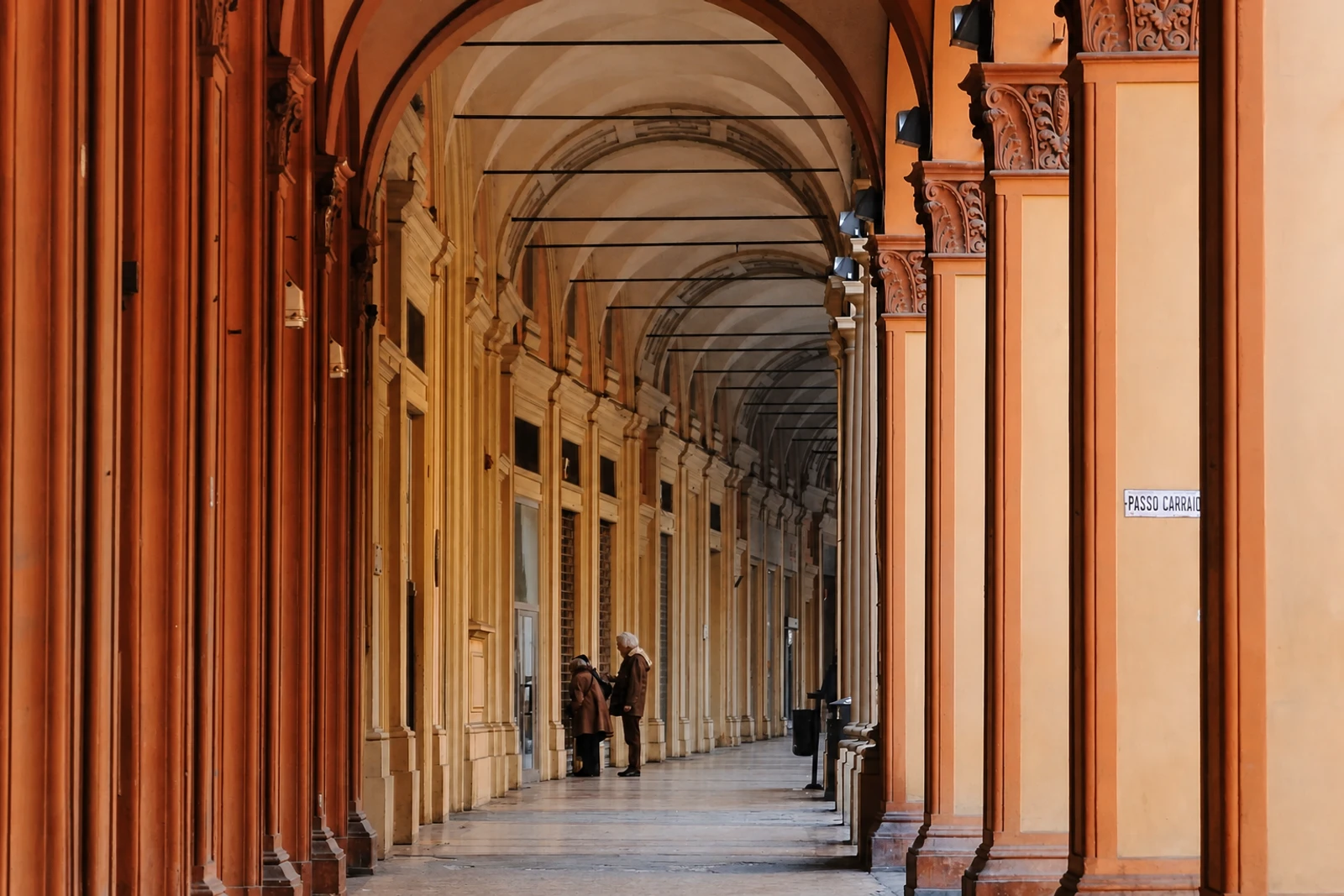
The Porticoes of Bologna: a public urban tradition in twelve ensembles
The Porticoes of Bologna belongs because it makes an ordinary act of city life—moving through streets—into the subject of World Heritage. Inscribed in 2021 under criterion (iv), the property comprises twelve selected ensembles within the Municipality of Bologna. They represent a much wider network of porticoed pathways extending for 62 kilometres, so the UNESCO property is not identical to every portico visible in the city.
Its distinction lies in variety and continuity. The selected examples include porticoes made of wood, stone, brick and reinforced concrete, covering roads, squares, paths and walkways on one or both sides of a street. Some form continuous covered passages; others belong to porticoed buildings that stand apart from adjoining structures. Working-class housing, aristocratic residences, public buildings and religious buildings show how the form served different parts of urban society. Twentieth-century concrete, especially in the Barca district, demonstrates that the tradition changed rather than becoming fixed.
Look for the relationship between architecture and public use. Porticoes remain private property for public use, providing sheltered walkways and locations for merchant activity, while also supporting exchange among citizens, migrants and students. The tradition was encouraged by a regulatory framework associated with the 1288 Statute and continued from the 12th century to the present. That makes Bologna different from a monument that is visited only for its façade: the listed value is also in how the city’s spaces are used.