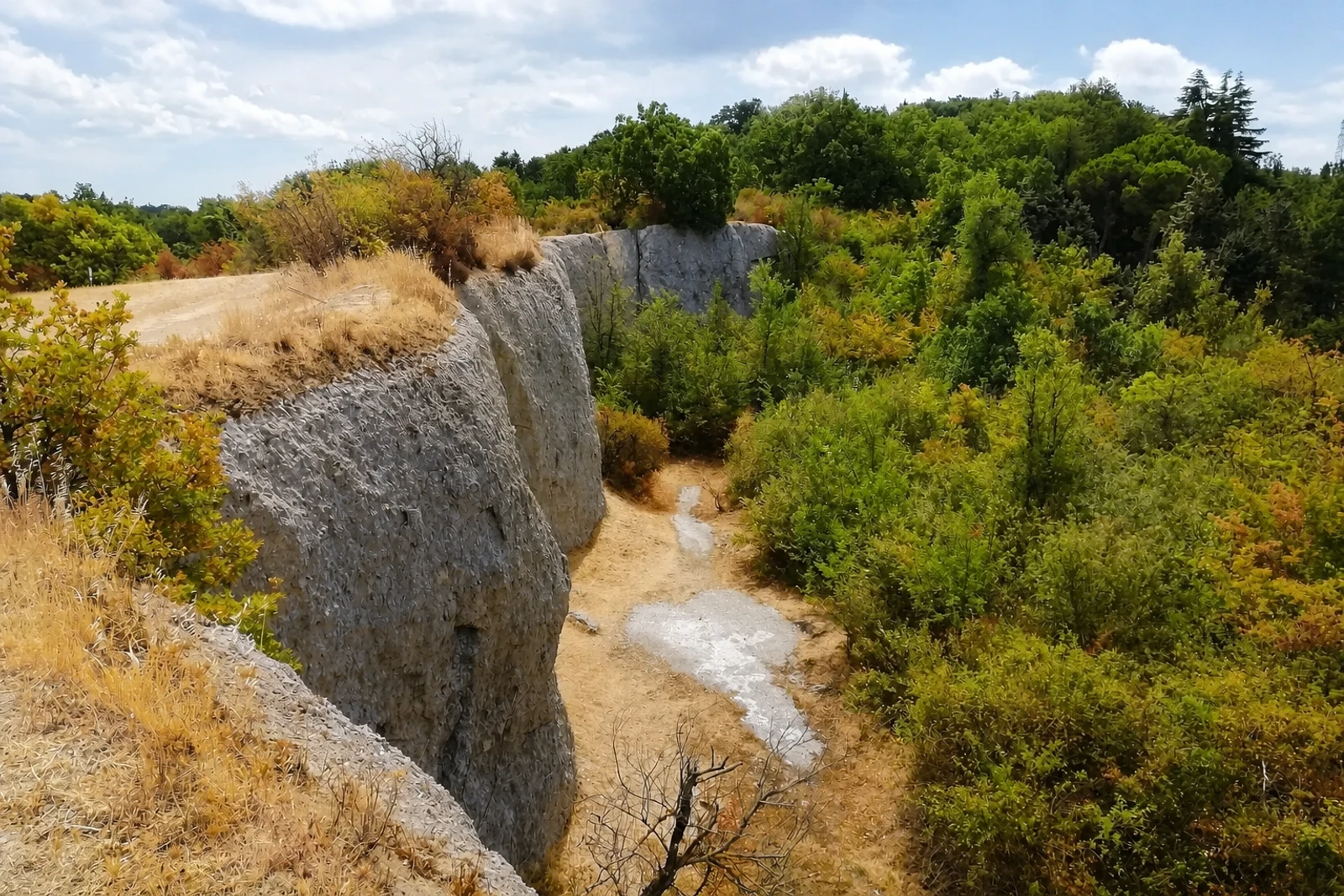
The gypsum world beneath the Northern Apennines
This natural property belongs for its unusually complete record of evaporitic karst formed in gypsum and anhydrite. Nine component parts occupy a narrow belt of vertical cliffs emerging from surrounding clays, linking exposed dissolution surfaces with underground caves, karst aquifers and recharge areas. It is not an architectural heritage site with a single focal building; its subject is the relationship between rock, water, climate and mineral formation.
The scale and variety distinguish it from a general cave landscape. UNESCO records more than 900 caves with a combined length exceeding 100 kilometres, including the 11.5-kilometre Spipola-Aquafredda-Prete Santo system and caves reaching 265 metres below the surface. The property also includes a hydrogeological tunnel longer than seven kilometres, gypsum cones, salt springs, speleothems and diverse minerals. These features together represent both epigean and hypogean karst morphologies.
Its geological story is equally important. The evaporitic rocks relate to the breakup of Pangea about 200 million years ago and the near-evaporation of the Mediterranean about six million years ago; the present cave systems developed over the last 500,000 years. Lapis specularis, transparent crystals used as glass in Roman times, adds a human association. Only a few caves are open to the public, so access to one cave should not be mistaken for access to the entire serial property. The systems are strictly protected, and gypsum quarrying is now prohibited.