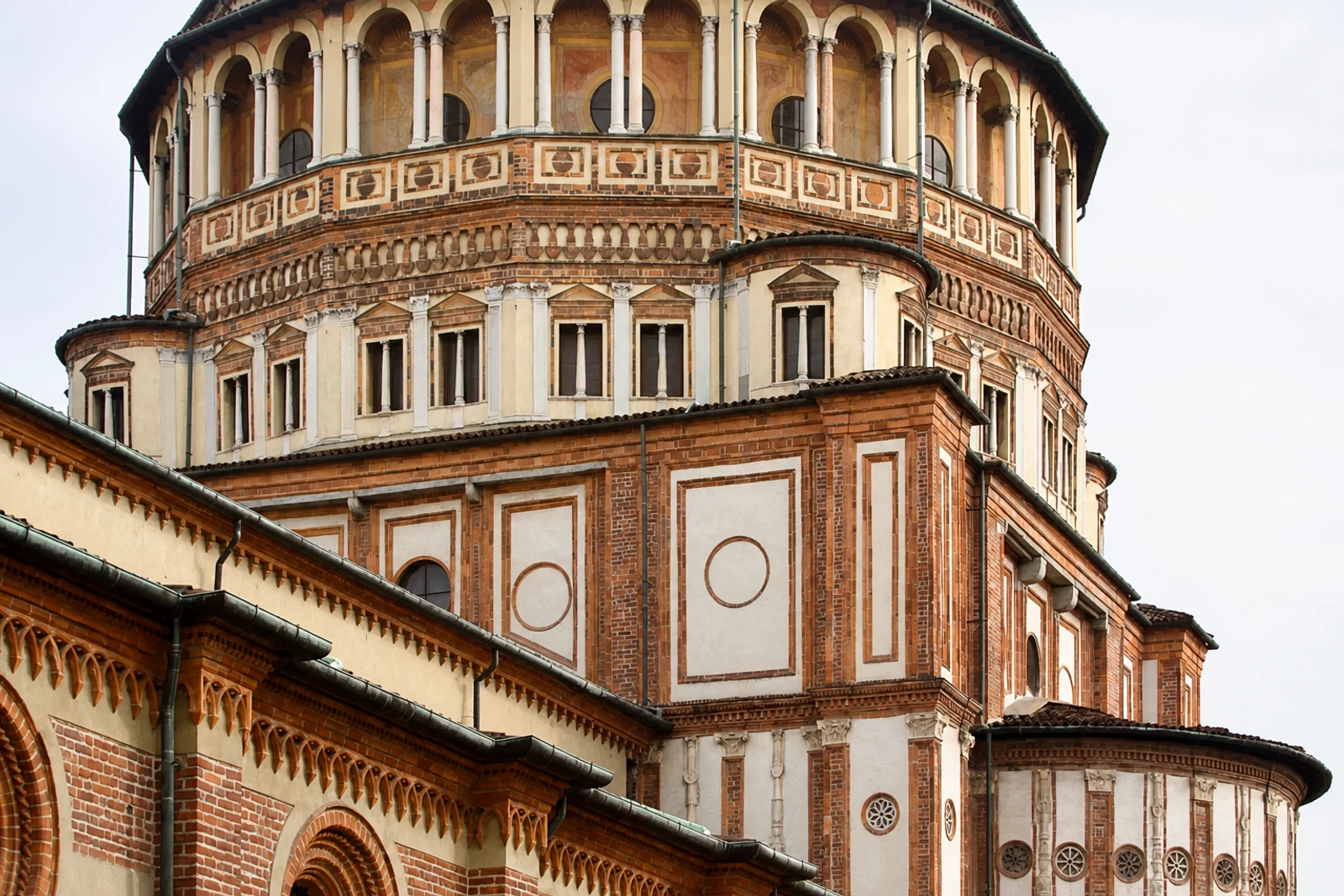
Santa Maria delle Grazie: Leonardo within a Renaissance complex
Santa Maria delle Grazie belongs on the map because UNESCO recognises the church, Dominican convent, refectory and The Last Supper as one architectural and artistic property. Begun in Milan in 1463 by Guiniforte Solari, the complex was substantially reworked at the end of the 15th century by Bramante. He enlarged the church and added large semi-circular apses, a drum-shaped dome surrounded by columns, a cloister and the refectory that houses Leonardo’s painting.
The Last Supper was commissioned in 1495 and completed in 1497 on the refectory’s north wall. Leonardo places Jesus among the Apostles at the moment immediately after Christ says that one of them will betray him. The figures are arranged in four groups of three, and their different reactions, movements and expressions make the brief instant the subject of the composition. Light and strong perspective are equally important. This distinguishes the work from a static religious image and helps explain its influence on the development of painting.
The painting should not be treated as an independent picture in a nearby room: its value is inseparable from the convent complex in which it was created. Its conservation history is also essential to what visitors are seeing. Leonardo used tempera on a two-layered plaster surface rather than fresco, creating long-term problems, and the work remains extremely delicate. The complex was badly damaged by bombing in 1943 but retained its architectural structure and internal relationships after restoration. Access is controlled because of conservation and visitation pressures. Inscribed in 1980 under criteria (i) and (ii), this is the map’s clearest choice for Renaissance architecture joined to a singular work of art.