Crespi d’Adda: the planned life of a company town
Crespi d’Adda belongs on this map because it preserves an unusually complete company town: factory, housing, services and civic buildings arranged as one working settlement. It lies in Capriate San Gervasio in Lombardy, between the Adda and Brembo rivers and the foothills of the Alps. Cristoforo Benigno Crespi founded the village for employees of his textile factory, while his son Silvio Benigno Crespi developed its final form after studying German and English cotton mills.
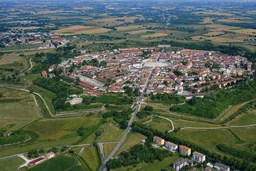
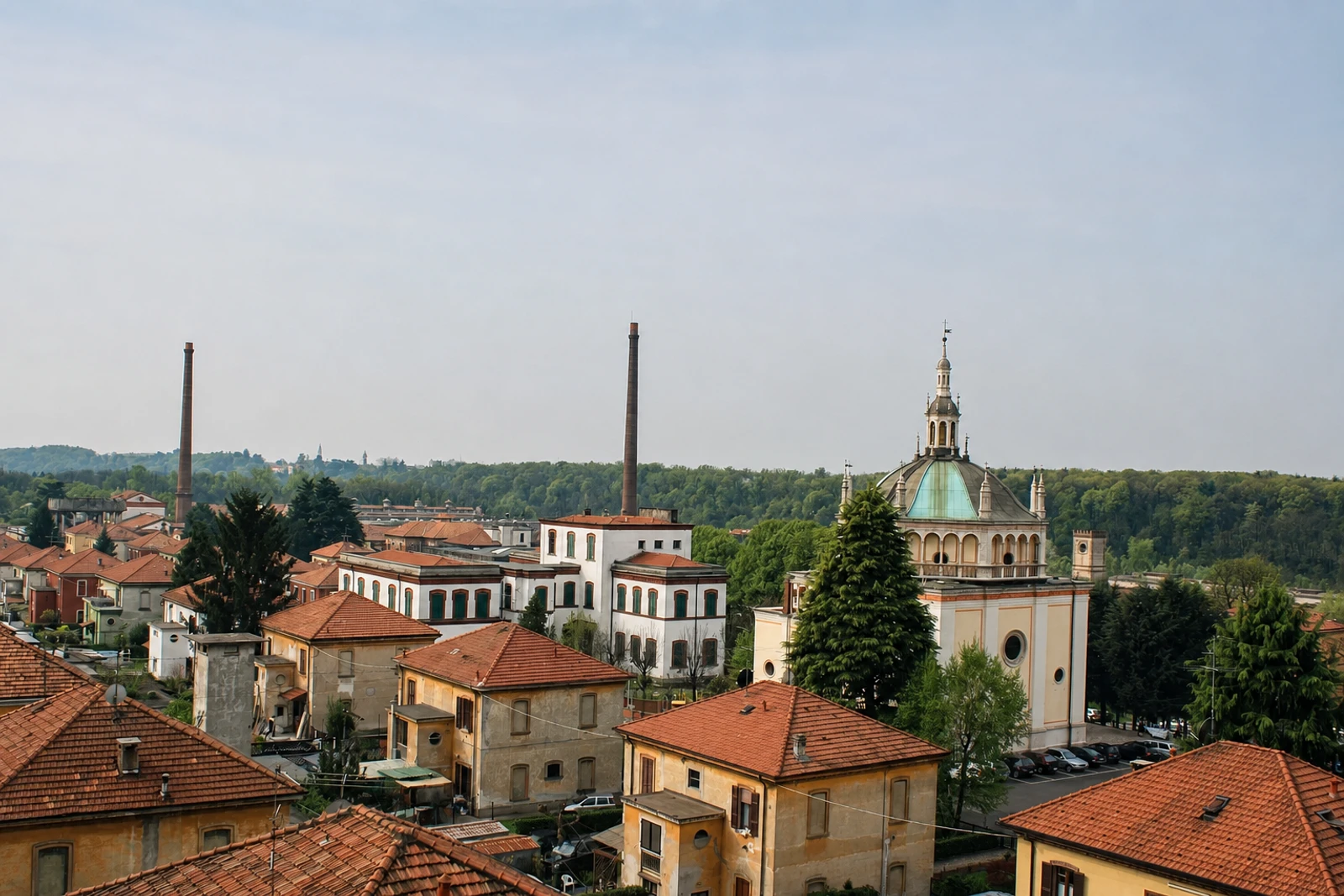
The settlement’s geometry makes its social organisation visible. A main road from Capriate bisects the town; factory buildings and offices stood on the left bank of the Adda, while the village occupied the opposite side in a rectangular grid of three lines. Multi-family residences had individual gardens, and houses varied in style according to the roles occupants held inside the factory. Services included a clinic, school, consumer cooperative, small theatre, sports centre, wash-houses and a hydroelectric station supplying free electricity. A church, castle, office complex and managers’ houses added symbolic and administrative distinctions.
This is not simply an industrial museum or a workers’ housing estate. Its World Heritage value lies in the preserved relationship between production, residence and community infrastructure. The town remained under one company’s ownership until the 1970s; many houses later passed to private owners, and industrial activity declined, with depopulation. Public, private and industrial buildings remain intact, although some colours and uses changed. Production continued until 2004. Inscribed in 1995 under criteria (iv) and (v), Crespi d’Adda is a cultural property whose future depends on maintaining an unusually complete urban structure amid changing economic and social conditions.