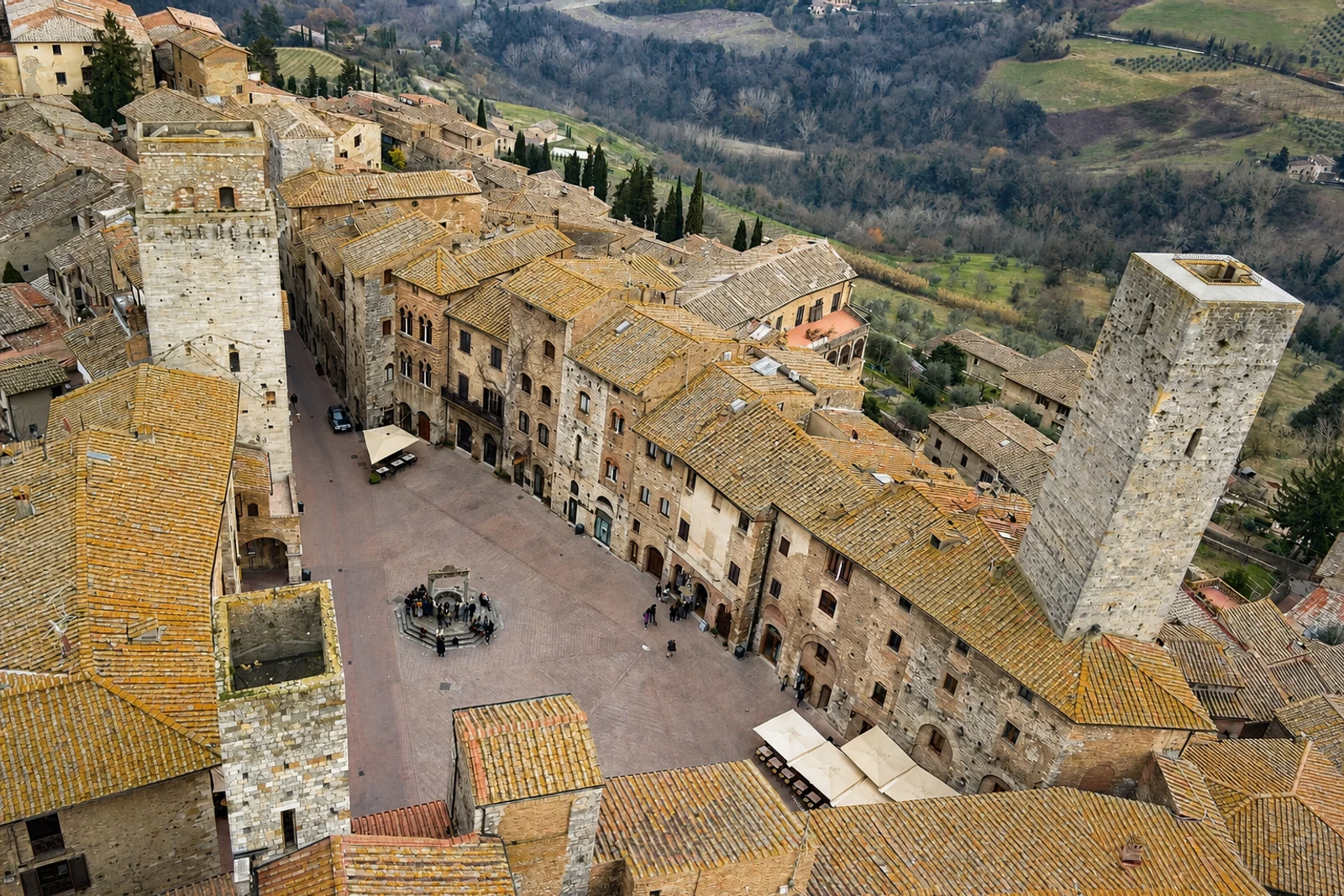
San Gimignano: towers above a medieval town plan
San Gimignano belongs because its value is concentrated in the preserved structure and appearance of a feudal Tuscan town. The cultural property was inscribed in 1990 and lies in Tuscany’s Val d’Elsa, where its position made it a relay point for pilgrims travelling along the Via Francigena. Noble families and prosperous merchants built about 72 fortified tower-houses as symbols of wealth and power; 14 survive, creating the skyline for which the town is readily recognised.
Its identity is more than a collection of towers. Two concentric defensive walls enclose streets, squares, noble palaces, churches, wells and fountains, with orchards occupying secondary streets and building-free areas. The triangular Piazza della Cisterna and the more intricate Piazza Duomo organise the historic centre. Within this compact setting, stone and terracotta decoration preserve a medieval urban fabric shaped by Florentine, Sienese and Pisan influences.
San Gimignano differs from Siena in the way power is written into the skyline. UNESCO contrasts its surviving family towers with the public-palace towers of Florence, presenting the town as an unusually clear expression of rival factions. It also differs from Pienza’s deliberate Renaissance composition: here, the importance lies in architectural homogeneity and an original medieval layout preserved after decline and Florentine control limited later urban renewal. Inside religious and public buildings, notice the 14th- and 15th-century Italian art in its original architectural settings.