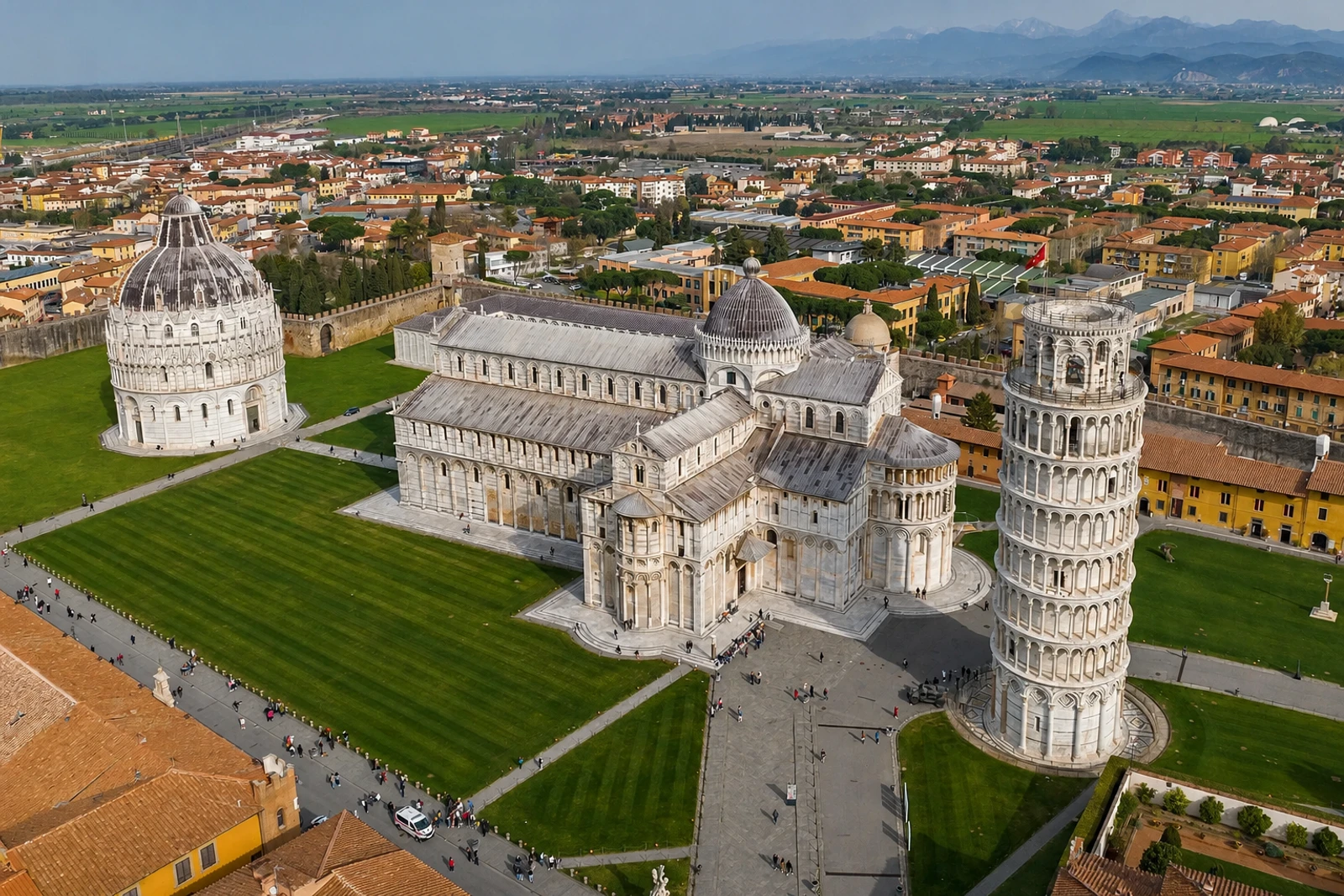
Pisa’s monumental meadow: four buildings, one medieval composition
Piazza del Duomo, Pisa belongs because its UNESCO value is concentrated in the relationship among four buildings: the cathedral, baptistry, campanile—the Leaning Tower—and cemetery. Inscribed in 1987 under criteria (i), (ii) and (iv), the cultural property stands within a large green expanse enclosed by the city walls and other historic structures. The cluster was formed between the 11th and 14th centuries, with buildings designed for distinct religious functions.
Its visual power comes from carefully contrasting elements: marble and mosaics, bare walls and arched galleries, triangular frontons and heavy cupolas, all heightened by the bell tower’s pronounced slant. The complex also contains bronze doors, cathedral mosaics, two important pulpits and the Campo Santo frescoes. The latter provide a significant chapter in Italian medieval painting, while the monuments together became a reference point for Pisan Romanesque architecture.
Pisa is not interchangeable with Padua’s fresco property. Padua asks visitors to compare dispersed cycles and artistic innovation across different interiors; Pisa offers a legible monumental ensemble whose spatial design is itself central. Nor is the tower the whole UNESCO property: the cathedral, baptistry and cemetery are essential to the recognised composition. The square developed from the foundation of the cathedral in 1064 to the definition of a true square in the 14th century, and its visual axes and relationships remain important attributes. Current access arrangements for individual buildings should be confirmed separately.