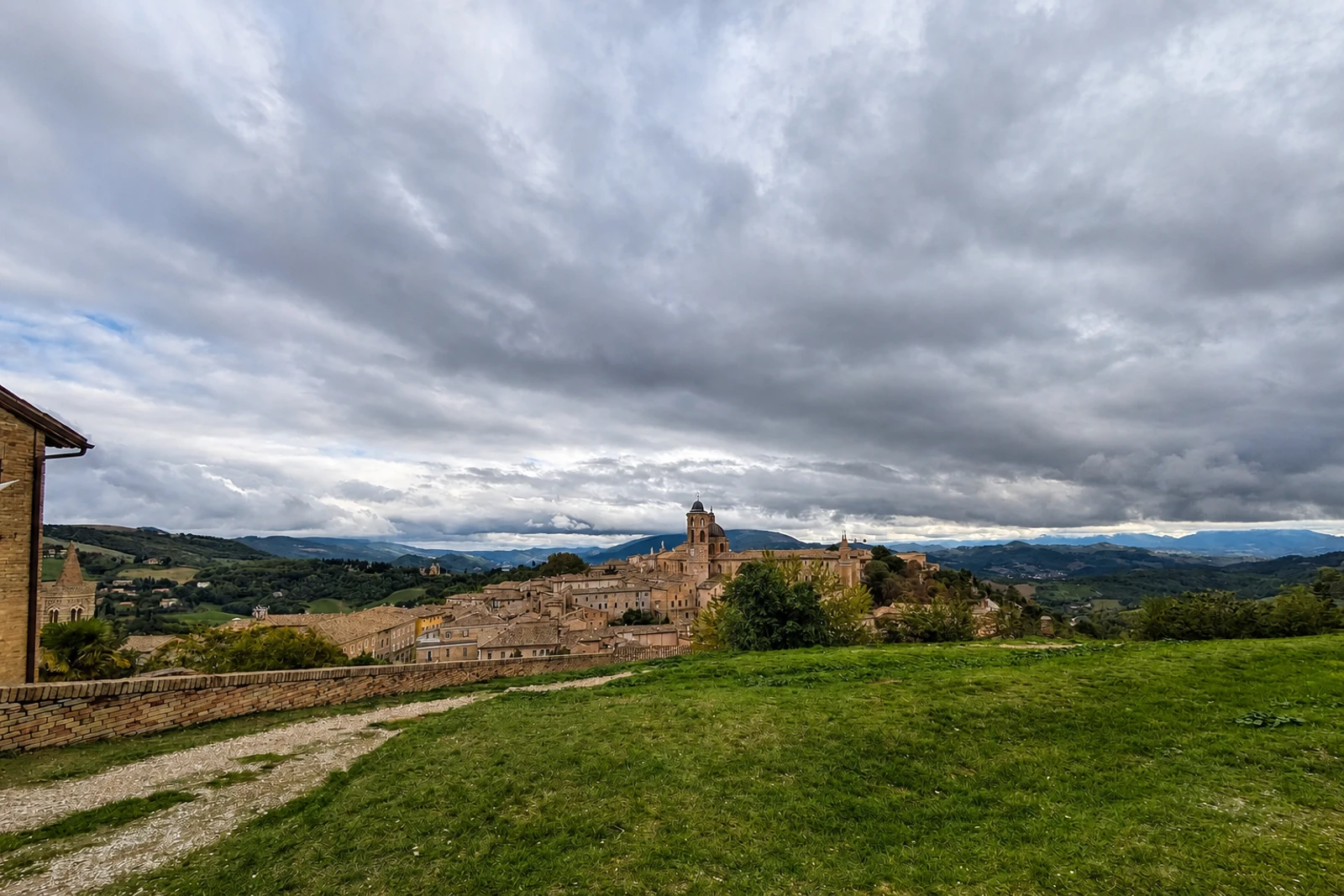
Urbino: a Renaissance court within older walls
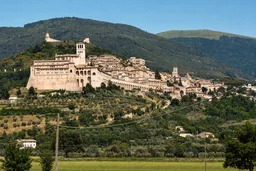
Urbino belongs as a hill city where Renaissance cultural ambition was fitted into a fortified medieval and Roman predecessor. The cultural property was inscribed in 1998. Its initial nucleus developed from a fortified Roman settlement on the hill now occupied by the Ducal Palace, and later expansion reached a second hill to the north. Renaissance walls, including their bastions, now define a continuous and unified historic centre with an elongated outline.
The decisive transformation came under Federico da Montefeltro, who ruled between 1444 and 1482. His court brought together humanists, mathematicians and artists, including Leone Battista Alberti, Marsilio Ficino, Luciano Laurana, Piero della Francesca and Paolo Uccello. Within the walls, the Ducal Palace, cathedral, Monastery of Santa Chiara and network of oratories express this cultural flowering. The rebuilding campaign was radical but did not disturb the overall urban structure.
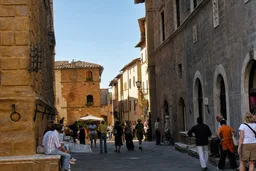
Urbino is not Pienza’s purpose-built ideal square. Its distinction lies in how Renaissance projects occupy and refine an existing hill town, retaining narrow medieval streets, spatial volumes and the older street layout. Economic and cultural stagnation after the 16th century helped preserve this appearance; even later interventions left the Renaissance plan almost untouched, despite some early 19th-century demolitions for expanded squares and roads. Traditional techniques and historical materials continue to inform maintenance and restoration, while national, regional and local controls protect the centre and its fortifications.