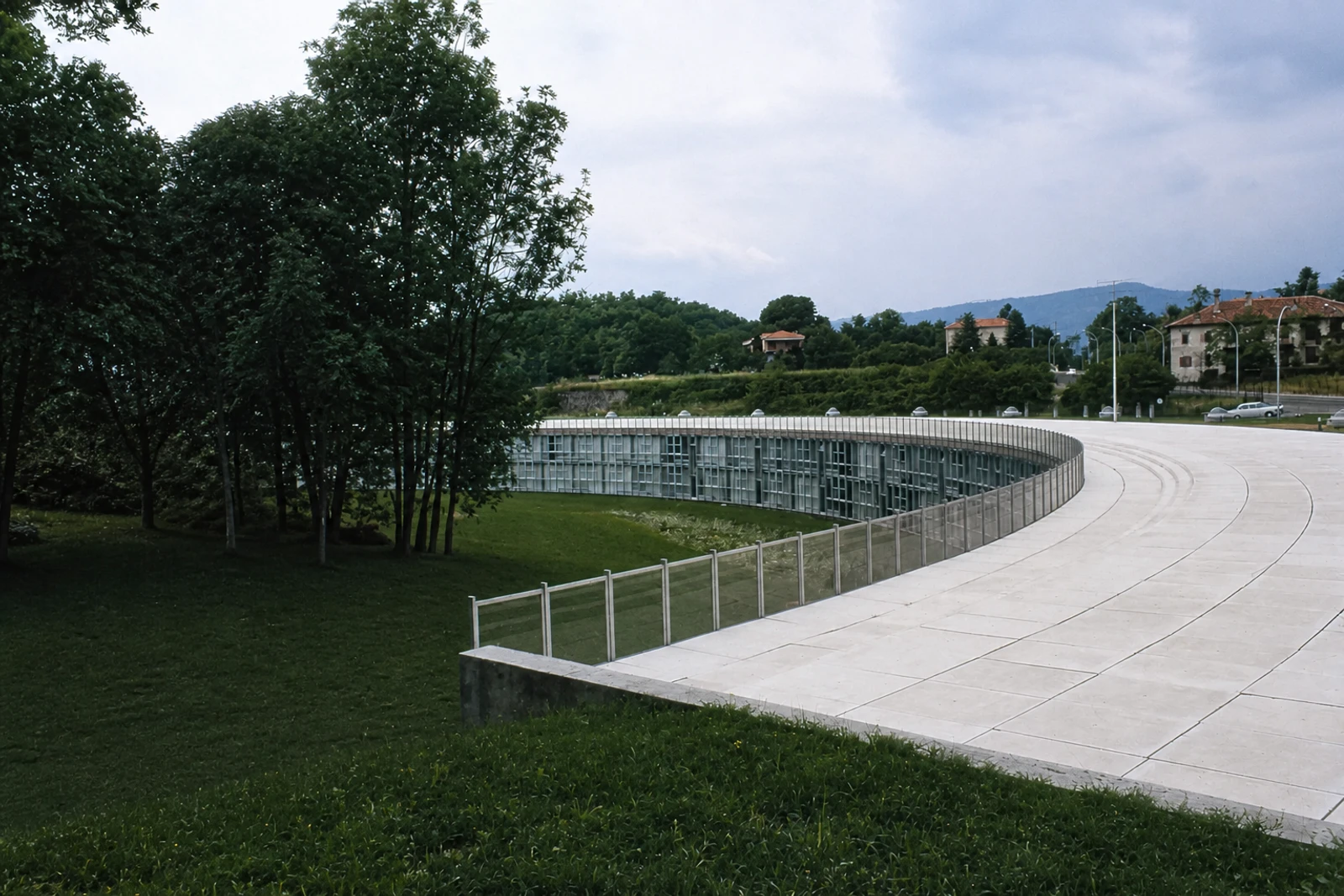
Ivrea: modern industry designed as a social city
Ivrea belongs because it extends Italy’s World Heritage story into the 20th century. The Piedmont property was inscribed in 2018 as a cultural site under criterion (iv). Developed as Olivetti’s industrial and socio-cultural project, it includes manufacturing, administration, social services, public spaces and residential units. The company made typewriters, mechanical calculators and desktop computers, making Ivrea a place where production, architecture and urban life were considered together.
Most of the city’s urban form and buildings were designed between the 1930s and 1960s under Adriano Olivetti, reflecting the Community Movement founded in Ivrea in 1947. The property is distinguished not by a preserved medieval plan but by a modern response to industrial change, including the transition from mechanical to digital industries. Its attributes include the spatial plan, public buildings and spaces, residential buildings and surviving interior elements.
Ivrea should not be mistaken for a conventional factory museum or for a historic centre whose importance rests mainly on age. UNESCO recognises an ensemble of modernist design and social provision, including the relationship between workplaces, services and homes. The record also sets clear conservation boundaries: functions have ceased in many non-residential buildings; some industrial buildings and interiors are deteriorating; many buildings are vacant; and new construction or large-scale refurbishment can affect authenticity. Residential buildings are often in good or adequate condition, but the property’s future depends on suitable uses and coordinated protection across national, regional and local authorities.