

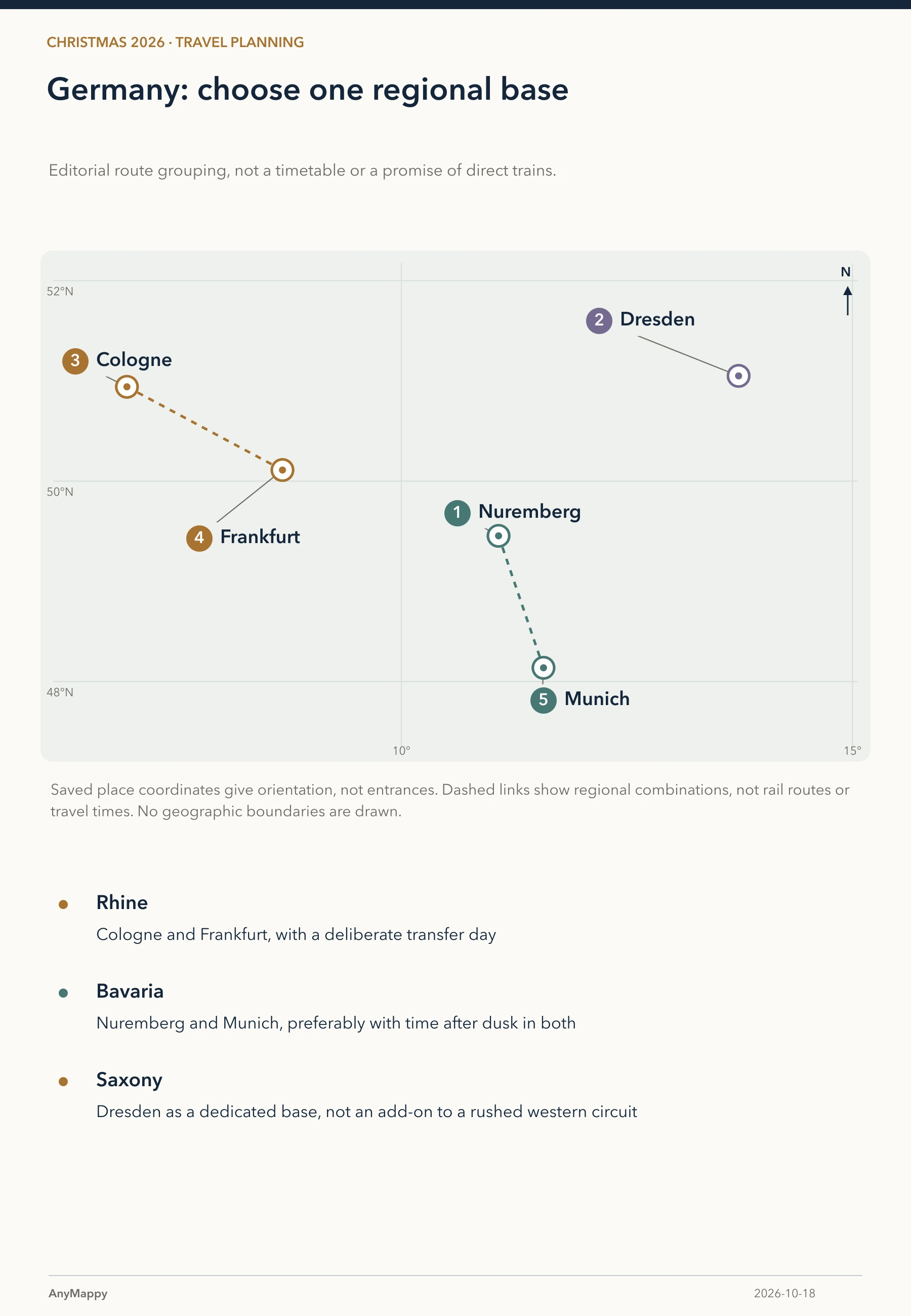
Editorial route grouping, not a timetable or a promise of direct trains. Saved place coordinates give orientation, not entrances. Dashed links show regional combinations, not rail routes or travel times. No geographic boundaries are drawn.
Enlarge the diagramRead the planning notes
- RhineCologne and Frankfurt, with a deliberate transfer day
- BavariaNuremberg and Munich, preferably with time after dusk in both
- SaxonyDresden as a dedicated base, not an add-on to a rushed western circuit
Choose the journey before choosing the prettiest photograph
| Base | Strongest fit | Suggested stay | Main compromise |
|---|---|---|---|
| Nuremberg | Classic first market trip | 2–3 nights | Tight central lanes at busy times |
| Dresden | Crafts, baking and art | 2–3 nights | Less natural fit with western Germany |
| Cologne | Train arrival and several market atmospheres | 2–3 nights | Markets are separate venues with separate dates |
| Frankfurt | Short stop and international arrival | 1–2 nights | Main market ends 22 December |
| Munich | Markets plus a longer Bavarian city break | 3 nights | More attractions can mean more ticket spending |
This comparison considers the festive character of the main market, the ease of arriving without a car, the range of useful daytime activities, and the effort required to combine nearby destinations. It is an editorial selection of five bases, not a measured popularity league table. A centrally located station does not make every airport convenient, and an attractive old town does not mean every street is level or accessible.
For a first trip with two or three nights, stay in one city. You gain an evening after arrival, a second chance if it rains, and somewhere to leave purchases before dinner. For four to six nights, two bases can make sense if the move follows your arrival and departure airports. Treat Dresden and the Rhine cities as different regional trips. Germany’s rail network can connect them, but that does not make a cross-country transfer a relaxing market afternoon.
The table gives suggested stay lengths, not minimum official visiting times. A night is not a full day: a late flight followed by an early departure leaves considerably less sightseeing than a booking calendar suggests.
2026 dates change which base works
The verified main-market seasons are Nuremberg, 27 November–24 December; Dresden, 25 November–24 December; Cologne Cathedral, 16 November–23 December; Frankfurt, 23 November–22 December; and Munich’s municipal Christkindlmarkt, 20 November–24 December. Munich starts earlier than many older guides suggest. Cologne Cathedral and Munich close on 22 November, Totensonntag; a season’s start and end dates do not imply uninterrupted opening.
Christmas Eve is a shortened trading day at many traditional markets, not a final full evening. If the market itself is your reason for travelling, a stay ending before 24 December is easier to plan. Do not book Frankfurt for a first market visit on 23 December based on a generic claim that German markets last until Christmas. Likewise, a winter attraction elsewhere in a city may continue after the main market has closed; its existence does not extend the dates of the named venue.
These dates were checked against organizer or city information on 18 October 2026. Some pages have current date banners alongside older program details. Recheck your exact venue and day shortly before departure, especially a workshop, procession or children’s event that matters enough to shape the trip.
Build a regional route with room for the evening
A Rhine trip can use Cologne and Frankfurt as two separate bases, connected by a booked intercity journey. Compare the actual service and station, not just a city’s name: Frankfurt Flughafen and Frankfurt Hauptbahnhof are different stops. Keep the moving day light, with luggage storage or hotel check-in before the market. A rail ticket with a cheaper headline price may be less useful if it leaves too little flexibility after a flight.
A Bavarian trip can pair Munich and Nuremberg. Decide whether the second city deserves an overnight stay by working backwards from the last evening you want there. A day trip that leaves before the lights come on misses the experience you travelled for. Dresden deserves its own eastern-Germany plan; use an additional nearby destination only after checking its own 2026 market dates and your return connection.
For two nights, resist the urge to add a long day trip. Spend one daylight period comparing crafts and another visiting a museum or indoor attraction. Return to the market later with a specific food or gift in mind. This produces a more varied trip than collecting hurried photographs of several squares.
Compare the whole bill, not the price of one drink
Use three spending categories. A market-focused trip prioritizes accommodation near a reliable transport link, public transport, simple meals and a small shopping allowance. A balanced city break adds a paid museum, a seated dinner and perhaps a guided activity. An experience-led trip adds concerts, multiple attractions or premium hotels. These are planning categories, not claims that one city’s hotel rooms are always cheaper than another’s.
Price the same dates and cancellation terms in each city. Include airport transfers, local tickets, intercity reservations, luggage storage and late-arrival meals. A hotel outside the centre may save on the room but cost you evening flexibility. Ask how late the last useful service runs and whether a change is required; the nearest station on a map is not always the easiest route with children or bags.
At stalls, distinguish the drink price from the refundable cup deposit. Keep the receipt or token when provided, ask which return point accepts the cup, and do not count a deposit as refunded until you actually return it. Carry a modest cash reserve without assuming every vendor refuses cards. For fragile ornaments, allow for packaging and luggage space; the cheapest gift can become awkward if it must survive several train changes.
Plan for wet weather, crowds and different mobility needs
A compact market can still be tiring: much of the visit involves standing, and crowds can turn a short lane into a slow passage. Arrange an indoor meal or café break before everyone becomes cold. With a stroller or wheelchair, consult the city and venue accessibility information for the exact route, toilets and station lifts. A general label such as “walkable old town” is insufficient.
Keep bags small and follow current security instructions. Pick a clear meeting point away from the busiest tree or stage, photograph it for your group, and agree what happens if mobile reception is poor. For a quieter browsing experience, try an earlier weekday session and return for a shorter visit after dusk; this is a practical strategy, not a guarantee of low crowds. Snow is never a booking promise, even in December.
Places in this article
Nuremberg: a focused introduction to the classic market
Nuremberg is the strongest fit when the market is the main purpose of the holiday. The Christkindlesmarkt on Hauptmarkt has a clear identity around traditional decorations, gingerbread and small local sausages. You can compare the stalls in daylight, explore more of the old town, and return after dark without changing neighbourhoods or buying a second attraction ticket.
Arrive through Nürnberg Hauptbahnhof and plan the final old-town approach separately from the rail journey. Choose accommodation according to whether you value an easy station arrival or a shorter walk back from Hauptmarkt. The castle area introduces slopes, so it should not be presented as a level extension of the market. For families, the separate children’s Christmas area offers a useful change of focus; check the current program and individual charges.
Two nights are a sensible starting allowance. Give the main square time, then choose one indoor visit according to your interests. The opening ceremony is a specific crowded event rather than the best default for everyone. Choose Nuremberg over Munich when you want a concentrated market break; choose Munich when major museums, shopping and a broader city itinerary matter equally.

Dresden: give crafts and baking a full day
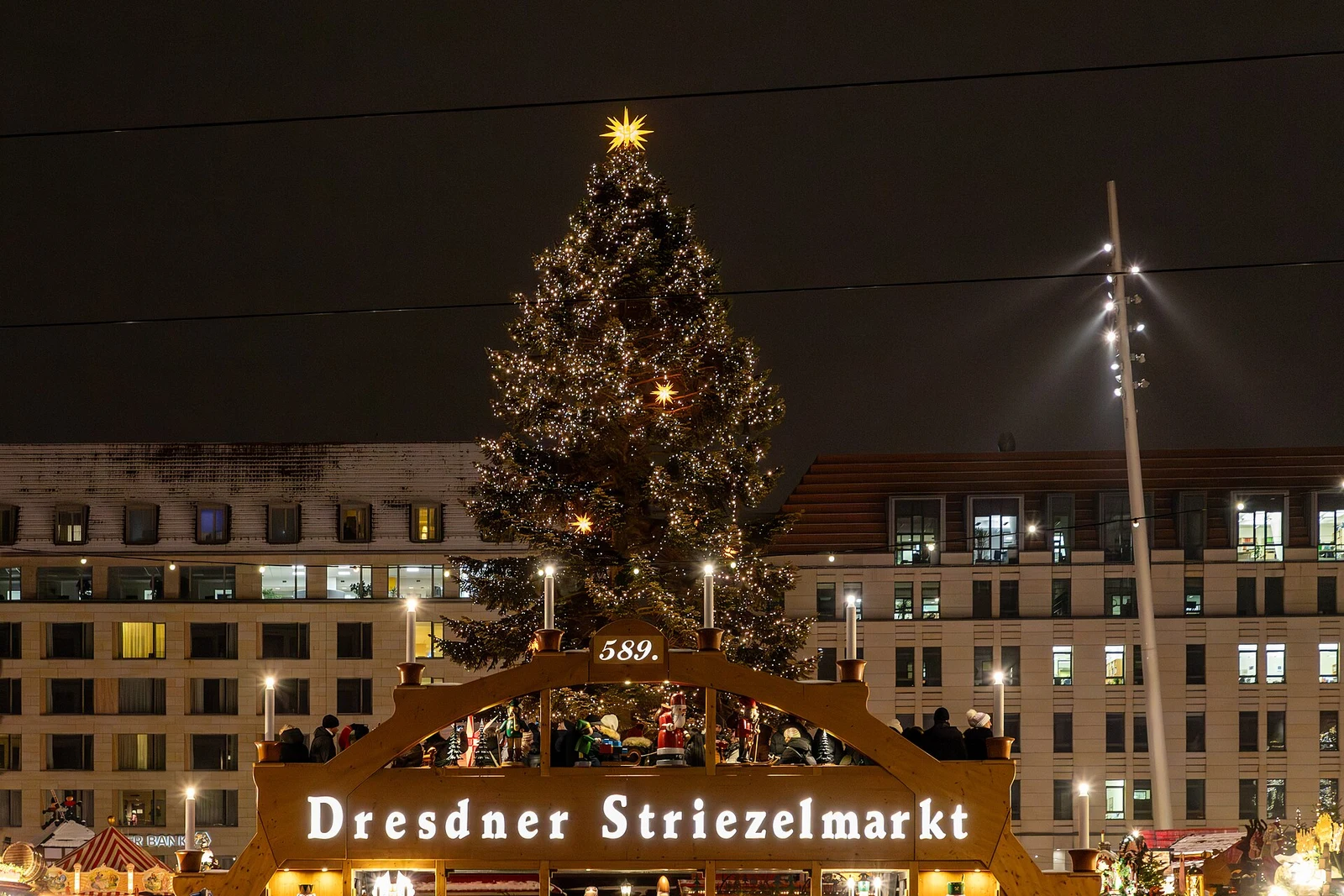
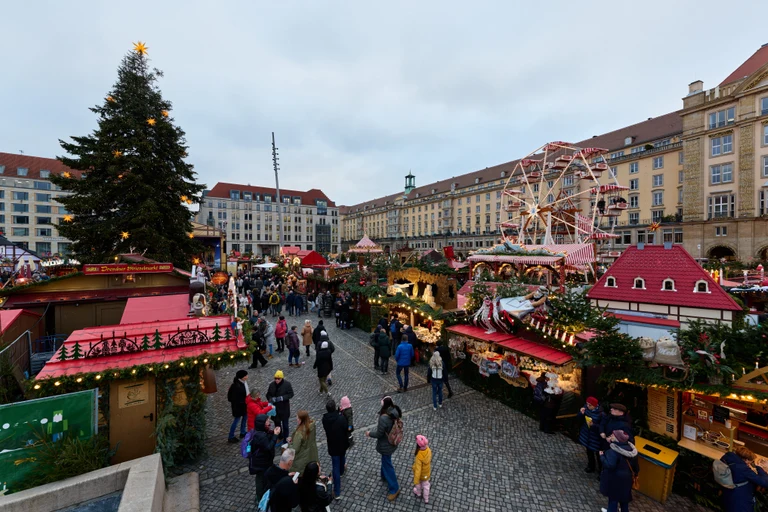
Dresden suits travellers who want the objects and food to explain something about the region. The Striezelmarkt on Altmarkt connects the Christmas visit with Saxon baking and Erzgebirge craft traditions. Look closely at materials, maker information and the construction of wooden ornaments before buying; “sold at a Christmas market” is not itself proof that every object is locally made.
The old-town market and major cultural sights form a workable city break, but museum collections and performances need their own opening and ticket checks. Build the day around one substantial cultural visit, a warm lunch and a later market session. Dresden Hauptbahnhof is a transport arrival point, not the market square itself: account for the final walk or tram and the winter weather.
The advantage over a rapid multi-city circuit is time to compare stalls and understand what you are buying. Dresden is less convenient if your trip already revolves around Cologne or Frankfurt; give it a dedicated regional stay. The 2026 season is confirmed, while some older program copy remains online, so avoid scheduling a procession from an undated social clip.
Cologne: strong rail access and a choice of settings
Cologne’s Cathedral market on Roncalliplatz makes a compelling first impression close to Köln Hauptbahnhof. This is a practical advantage for train travellers, especially on a short stay: the arrival landmark and principal market are close together. It does not remove the need to store luggage before entering busy stalls or to verify the accessible route out of the station.
The city’s appeal is variety. Use the cathedral market as an anchor, then select one other market area for a different setting instead of trying to sweep every venue in an evening. Separate organizers can mean different end dates, opening hours and charges for skating or rides. A photograph of an ice rink elsewhere in Cologne should not be described as a facility inside the cathedral market.
Choose Cologne when your transport naturally brings you to the Rhine and you prefer several shorter visits. Pair it with a daytime cathedral or museum visit after checking entry conditions. If arriving on 22 November 2026, the cathedral market is closed for Totensonntag; build that day around other confirmed activities or change the timing.
_2.jpg)
Frankfurt: the practical short-stay choice
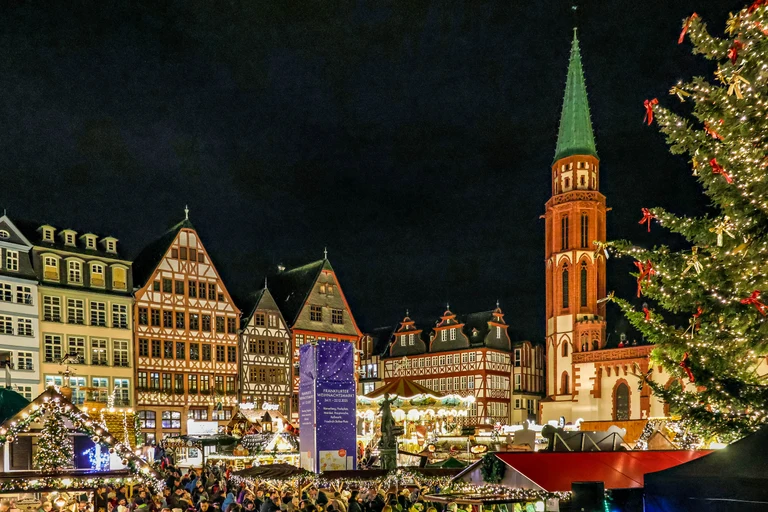
Frankfurt works well when the available holiday is a stop of one or two nights rather than a dedicated week. Its market links Römerberg with other central squares and the Main riverfront, allowing you to choose a shorter section if arrival is delayed. Bethmännchen and hot apple-wine traditions give the visit a local dimension beyond a skyline photograph.
An international airport connection is useful, but an airport layover is not automatically a safe market excursion. Count border formalities where applicable, luggage, the journey in both directions, airport reporting requirements and disruption margin. For an overnight stop, a central hotel can turn a rushed excursion into a proper evening. Keep the route focused on Römerberg and adjacent areas, with a seated meal if the weather is poor.
The main market ends on 22 December 2026, earlier than the other four main markets in this comparison. That makes it a poor default for a trip beginning on Christmas Eve. Choose Frankfurt for fit with your transport and limited time, not because its role as a hub proves that every onward journey is fast or inexpensive.
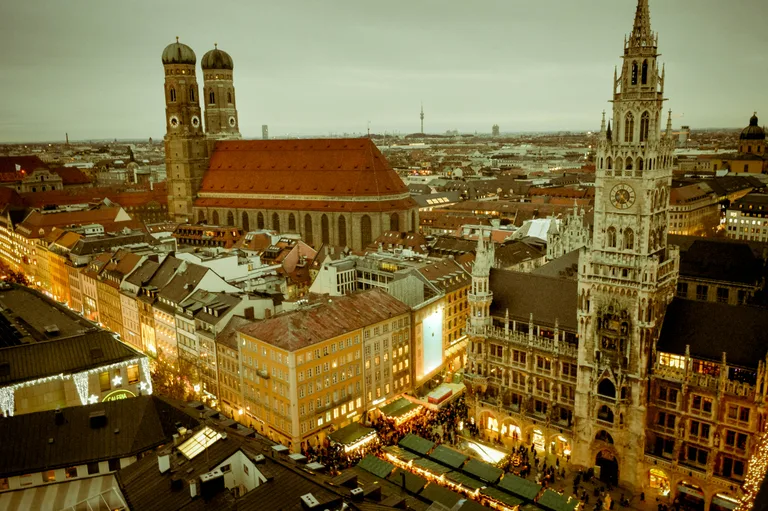

Munich: the broad city-break option
Munich is a good base when Christmas is one part of a larger holiday. The municipal market centres on Marienplatz and Rindermarkt, with the nativity-market tradition near St Peter’s adding a distinct shopping interest. Public transport allows you to combine the centre with museums and other neighbourhoods without treating every outing as a long-distance excursion.
Its 2026 opening moves to 20 November, but the 22 November closure matters for an early-season weekend. Other Munich Christmas markets follow their own calendars; choose each on its merits and location. An airport-market visit is not interchangeable with a visit to the municipal market at Marienplatz.
Allow three nights if you want a substantial museum day or a second festive neighbourhood. Avoid stacking an ambitious mountain excursion, a major museum and the main market into one short winter day. Munich is the better choice than Nuremberg for breadth; Nuremberg is the more focused choice when you want the traditional market to shape nearly the entire stay.
Which German city should a first-time visitor choose?
Start with Nuremberg for a focused traditional-market trip, then compare the total journey with Cologne or Munich. A simpler arrival and an extra evening can be more valuable than a nominally higher recommendation.
Can I visit all five cities in one week?
It is physically possible to construct a rail itinerary, but it would devote a large share of the week to packing and transfers. Choose one region and at most two bases unless the rail journey itself is a principal interest.
Are the markets open on Christmas Day?
The five named main markets all finish by 24 December, and Frankfurt and Cologne finish earlier. A separate winter event may remain open, but it needs independent confirmation.
Do I need a car?
A car is unnecessary for these central-city plans. Compare the exact airport or railway connection with your hotel, and use public transport or walking for the final approach. Village excursions are a different question.
Is early December better than the opening weekend?
Early December gives all five main venues an overlapping season, but weather and crowds remain variable. Midweek dates can make browsing easier; hotel prices and your own transport options should decide the final choice.