
.jpg)
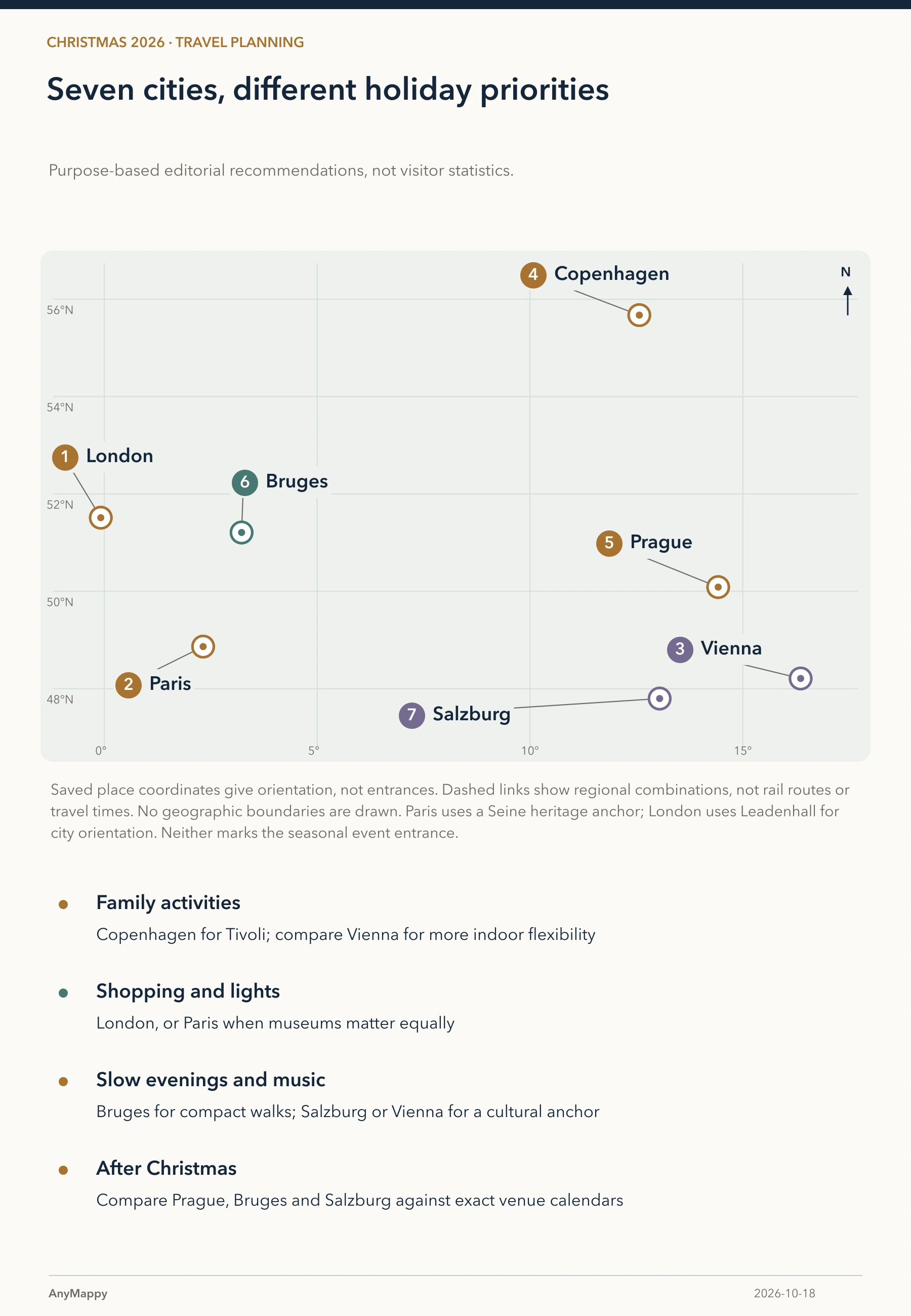
Purpose-based editorial recommendations, not visitor statistics. Saved place coordinates give orientation, not entrances. Dashed links show regional combinations, not rail routes or travel times. No geographic boundaries are drawn. Paris uses a Seine heritage anchor; London uses Leadenhall for city orientation. Neither marks the seasonal event entrance.
Enlarge the diagramRead the planning notes
- Family activitiesCopenhagen for Tivoli; compare Vienna for more indoor flexibility
- Shopping and lightsLondon, or Paris when museums matter equally
- Slow evenings and musicBruges for compact walks; Salzburg or Vienna for a cultural anchor
- After ChristmasCompare Prague, Bruges and Salzburg against exact venue calendars
How to use these seven recommendations
| City | Strongest fit | Suggested stay | Main limitation |
|---|---|---|---|
| London | Street lights and shopping | 3 nights | 25 December transport and venue closures |
| Paris | Museums, retail and varied neighbourhoods | 3–4 nights | Some 2026 market details still pending |
| Vienna | Music, museums and several festive settings | 3 nights | Paid add-ons can accumulate |
| Copenhagen | Tivoli and a contained family outing | 3 nights | Admission and ride budgets are distinct |
| Prague | Historic scenery and a later central-market season | 3 nights | Cobbles and crowded routes |
| Bruges | A compact couple’s or slow overnight break | 2 nights | Small streets do not guarantee low crowds |
| Salzburg | Music and a smaller old-town stay | 2–3 nights | Do not make the plan depend on city snow |
We considered activities beyond the markets, public-transport practicality, indoor alternatives, the likely amount of walking, and confirmed versus pending holiday information. A city recommended for families is not a guarantee that every ride accepts every child, and a city recommended for couples is not a claim that it will be quiet. Preferences and limitations matter more than an invented numerical score.
Choose one priority and one backup. A family might put Tivoli rides first and indoor breaks second. A couple might put compact evening walks first and music second. A shopper might put London’s stores first and free street lights second. If everything is equally essential, the itinerary becomes too crowded to enjoy any one part well.
The suggested stay lengths below are editorial allowances for the city itself. Add travel days and consider arrival time, rather than assuming three booked nights equal three full days. A longer stay in one city can cost less in both money and energy than a succession of shorter stops with repeated transfers.
For families: compare effort as well as attractions
Copenhagen is the clearest choice here when the family wants rides and a festive attraction in one venue. Tivoli is close to the central railway station, but that convenience does not remove the need to check height restrictions, admission products and weather policies. Buy a ride product only when enough members of the party will use it. A grandparent who mainly wants to walk through the gardens may need a different ticket decision from a teenager seeking repeated rides.
Vienna is worth comparing when indoor culture and flexible public transport matter more than amusement rides. Choose one museum or activity suited to the children’s age, then a shorter market visit. London offers many possibilities but also more opportunities to overbook. A single lights area plus a booked activity can be enough for one day.
In every city, plan a warm seated meal, toilets and an early exit option. A stroller’s comfort depends on paving, crowd density and station access, not the city’s marketing category. Ask about specific facilities rather than interpreting “family friendly” as a promise of quiet spaces, step-free routes or free child admission.
For couples: choose the scale of the evening
Bruges and Salzburg are good candidates when the desired experience is a shorter walk, an atmospheric centre and a meal without a long cross-city journey afterwards. Stay overnight rather than arriving on a rapid excursion if the evening is the point of the holiday. A central hotel may provide useful flexibility, but compare real quotes and cancellation rules before assuming that convenience is affordable.
Paris and Vienna suit couples who want the day to include a major collection, performance or restaurant booking. Choose the cultural event first, then build a nearby festive walk around it. The best use of a market may be a short early-evening visit rather than an obligation to remain outdoors for hours.
Avoid equating romance with empty streets. All seven cities can be busy in popular areas. A weekday stay, a morning walk and a deliberately slow lunch can provide a different rhythm, but no article can guarantee crowd levels. For a celebratory dinner, confirm the current menu and deposit terms directly instead of relying on an old social-media recommendation.
For a controlled budget: reduce changes before reducing comfort
A holiday budget has four large components: the journey, accommodation, daily meals and paid experiences. Market snacks and small souvenirs matter too, but a second hotel move or an airport transfer can outweigh several cups of hot chocolate. Compare the same travel dates and room occupancy in each city, with luggage and cancellation conditions included.
A street-light itinerary in London can be low in activity spending even when the room is costly. Prague should not be assumed cheap simply because it uses a different currency. Copenhagen’s Tivoli visit needs admission and ride budgeting; Vienna’s concerts and museums can raise an otherwise modest market plan. Bruges and Salzburg have compact centres, but seasonal room demand can still matter. These are cost structures, not unverified city-by-city price rankings.
Choose one paid highlight, a reliable base and a flexible public-space walk. Keep local-currency cash or payment options appropriate to the venue, understand refundable cup deposits, and check whether a transport pass covers the journeys you will actually make. A pass does not save money merely because it has many attractions printed on it.
If you travel on 24–26 December, let the calendar decide
This is the most important filter for a holiday spanning Christmas itself. London’s Winter Wonderland is closed on 25 December, and official tourism guidance says public transport does not operate that day. Plan meals and airport travel separately. Paris market dates are not uniformly confirmed in the official roundup checked, and a museum or shop may have its own closure regardless of nearby decorations.
Vienna’s Rathausplatz market is confirmed through 26 December 2026, with shorter hours on 24 December. Salzburg’s Dom- and Residenzplatz market runs to 1 January 2027 and publishes special hours for 24–26 December. Prague’s central-market season is listed to 6 January, Bruges’ two markets to 3 January, and Tivoli’s advertised Christmas season to 3 January. These longer seasons create options; they do not establish normal operating hours for every attraction or restaurant.
Confirm the exact date of the experience that makes the trip worthwhile. Book the essential meal before everything else fills up, and keep the day’s transport simple. A quiet holiday can be enjoyable when planned around a small number of confirmed activities. It is a poor time to depend on spontaneous shopping or a dense list of unverified events.
Choose a city you would still enjoy in rain
Christmas imagery often suggests snow, but none of these urban trips should depend on it. Wet pavements, cold wind and short daylight can change the pace. Put architecture and longer walks into the daylight period, schedule one indoor anchor and use the evening for a shorter festive circuit. Reserve a warm place to sit before the group is exhausted.
Copenhagen’s garden attraction, Prague’s cobbles and Bruges’ narrow streets all ask different things of visitors. A place can be geographically compact yet physically demanding. Check step-free access, accessible toilets and venue-specific assistance through the operator. Keep historical photographs labelled by year, and treat videos as an impression of a place rather than proof of the coming season’s programme.
If the weather turns, remove an optional stop instead of compressing the same list into less time. A two-night stay with one memorable evening and a good indoor day can be more successful than a five-city tour that never gives you time to settle.
London: lights and shopping with a clear spending choice
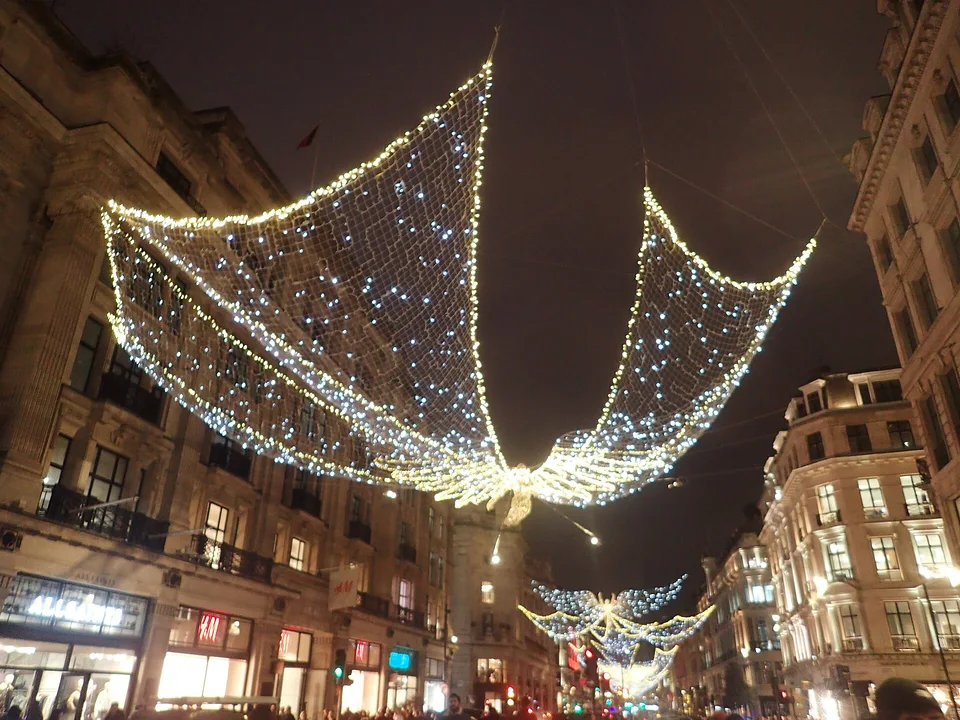

London is the strongest recommendation when the group wants public street displays and a broad choice of stores. Oxford Street, Regent Street and Covent Garden can form a connected West End route, while Knightsbridge belongs in a separate west-London block. This makes it possible to browse, stop for food and shorten the walk without needing a ticket for every experience.
For a major paid outing, Winter Wonderland’s 2026 season runs 19 November–3 January, except 25 December. All visitors need an entrance ticket; rides and attractions are separate decisions. Choose London when this mix of freely accessible streets and optional entertainment suits the group. Choose somewhere else if the ideal Christmas Day depends on normal public transport, spontaneous shopping and several open attractions.
Paris: the broad cultural holiday with a festive layer
Paris suits travellers whose wish list already includes museums, neighbourhood walks and department stores. The festive element can connect those interests without controlling the entire holiday. Organise each half-day around one area: a central museum and the Tuileries district, an Opéra shopping session, or a Left Bank walk. A confirmed market can then become a nearby addition.
The limitation is current schedule confidence. The official Paris market roundup consulted still described 2025 despite a 2026 update date, so we do not promise that the Tuileries or La Défense event will operate on your chosen 2026 day. Paris remains a sensible whole-city recommendation because its appeal extends beyond a single seasonal event. Verify museum, restaurant and store holiday hours independently.
Places in this article

Vienna: music and museums with flexible festive evenings
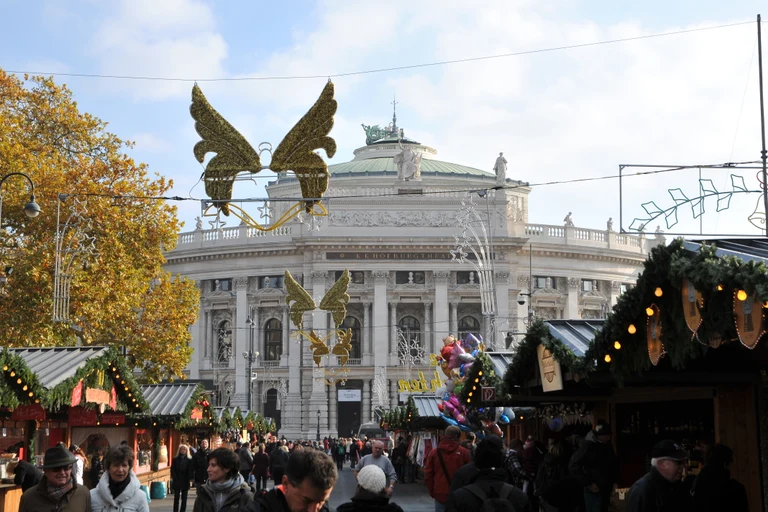
Vienna is the best match here when a holiday should combine a major indoor attraction with an evening market. Rathausplatz provides a strong central festive setting, and the city’s transport network lets you design shorter outdoor periods around cafés, collections or a booked performance. Choose one cultural event according to your interests rather than buying a concert solely because it is advertised to tourists.
The Rathausplatz market runs 13 November–26 December 2026. Its skating operation follows a different calendar, so a photograph of ice paths cannot be used as a market schedule. Compare the complete price of admission, seats and any food package for music events. Vienna suits travellers who value variety, but a schedule filled with separately ticketed experiences can become costly and rushed.
Copenhagen: a family outing built around Tivoli
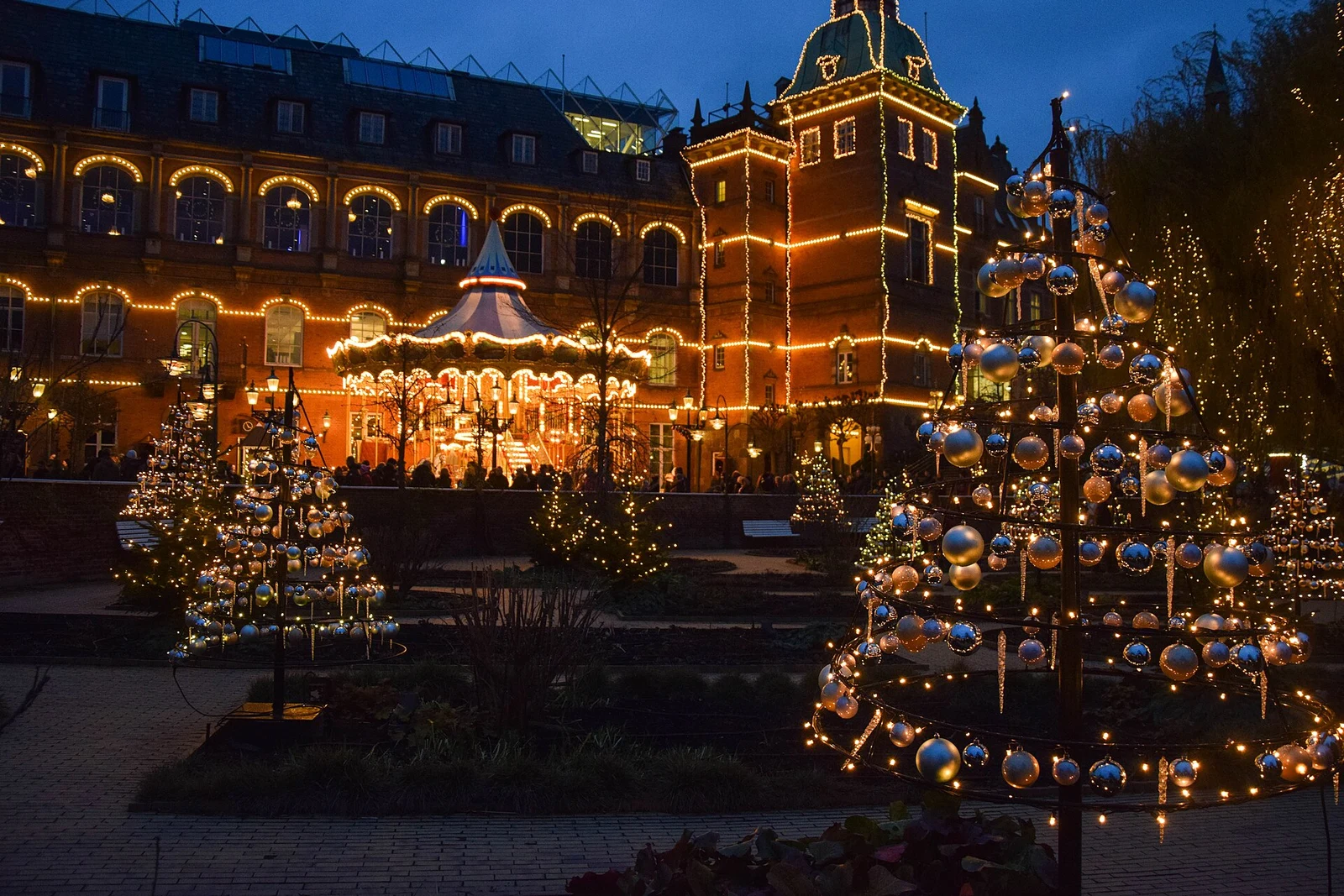
Copenhagen is a clear choice when the festive holiday needs a dedicated attraction as well as city streets. Tivoli combines decorative gardens, market stalls and rides close to the central station. The operator advertises a Christmas season from 13 November to 3 January, corroborated as 2026–27 by official tourism date fields. Check the calendar for the specific visiting day.
The key decision is what the family actually wants to do. Admission, ride access and particular experiences are not the same product. Review restrictions before paying, allow a meal break and avoid counting on every ride operating regardless of weather. Give the city another day beyond Tivoli, with an indoor plan that suits the group. This is a stronger fit for an activity-led family trip than for travellers seeking only free, traditional market browsing.
Prague: architecture and a later central-market season
Prague works well for travellers who want historic urban scenery and cannot travel until after Christmas. Official city listings put the central Old Town Square and Wenceslas Square market season at 28 November 2026–6 January 2027. A daylight architecture walk and a later market visit can therefore serve different purposes without needing a new city each day.
Keep the route realistic. Cobbles, crowds and the climb towards the castle district can be tiring, especially with a stroller or limited mobility. A compact old-town day and a separate castle-side day are more comfortable than a continuous all-day circuit. Read prices and portion units carefully and compare spending in Czech koruna. A long market season does not mean ordinary museum or restaurant opening on every public holiday.
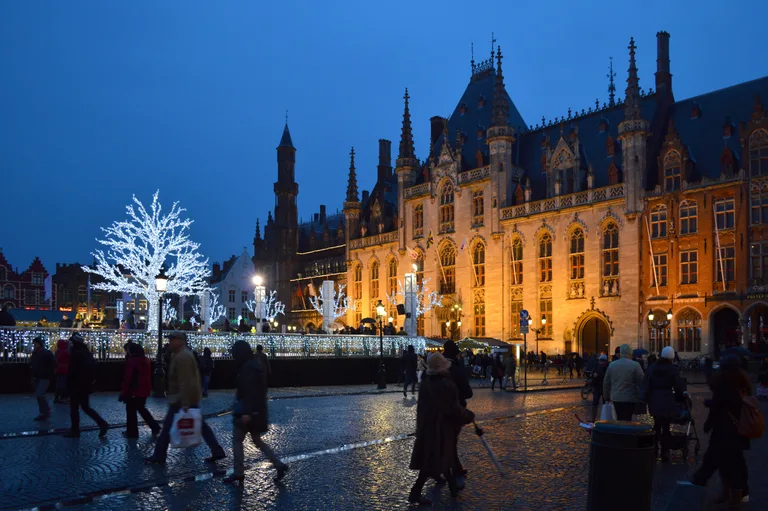

Bruges: a compact stay where the overnight matters
Bruges is a good fit for a slower couple’s break or anyone who prefers a small historic centre to a large capital. The two Christmas markets are confirmed for 20 November 2026–3 January 2027. Use an overnight stay to see the streets before and after the busiest excursion hours, take a seated meal, and return to the centre without watching the last train throughout the evening.
The Christmas markets should not be confused with every feature of Winter Glow. Some official ancillary pages still label their information as the previous 2025–26 edition, so an old light trail or skating location is not automatically a 2026 promise. Narrow streets and cobbles also mean “compact” is not a universal accessibility claim. Choose Bruges for scale and a slower rhythm, while confirming the exact seasonal activity that interests you.
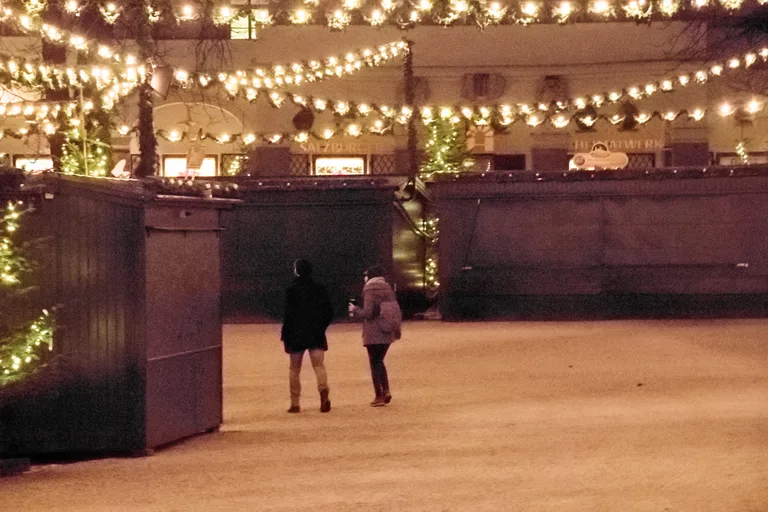

Salzburg: a smaller music-focused Christmas stay
Salzburg suits travellers who want a recognisable old-town setting, musical interests and a less sprawling itinerary than a capital. The Dom- and Residenzplatz market runs 19 November 2026–1 January 2027, including published shorter hours over Christmas. A concert or cultural visit can anchor the daytime or evening, with the market woven around it rather than becoming the only activity.
Choose the city for that urban experience, not a guarantee of snow or an assumption that every Alpine excursion is simple in winter. A mountain outing requires its own transport, weather and operating checks and can consume most of a short day. Two or three nights allow a more relaxed rhythm. If travelling on 24–26 December, confirm the meal and the specific music booking as carefully as the market hours.
Which city is best for families?
Copenhagen is the clearest choice for a trip centred on Tivoli rides and scenery. Vienna may suit families who prefer museums and shorter outdoor sessions. Check age, height, access and ticket rules for the exact activities.
Which city is best for a couple’s short break?
Bruges or Salzburg can suit a compact, slower stay; Paris or Vienna is stronger for a major cultural programme. The choice depends on whether you want a small evening circuit or more varied city activities.
Which destination is cheapest?
There is no verified universal winner here. Compare flights or rail, the same hotel dates and room type, local transfers and the paid experiences you will actually use. Currency differences alone do not prove value.
Where can I still visit a market after Christmas?
The named seasons include later options in Prague, Bruges, Salzburg and Copenhagen, with Vienna Rathausplatz through 26 December. Check the exact day, venue and holiday hours; do not generalise across a city.
Can I combine all seven on one trip?
They span a large part of Europe and are intended as alternatives. For a week, choose one or two compatible bases and preserve time for evenings, indoor visits and unhurried transfers.